
Third Place Qualification: How It Works at World Cup 2026
 Available in US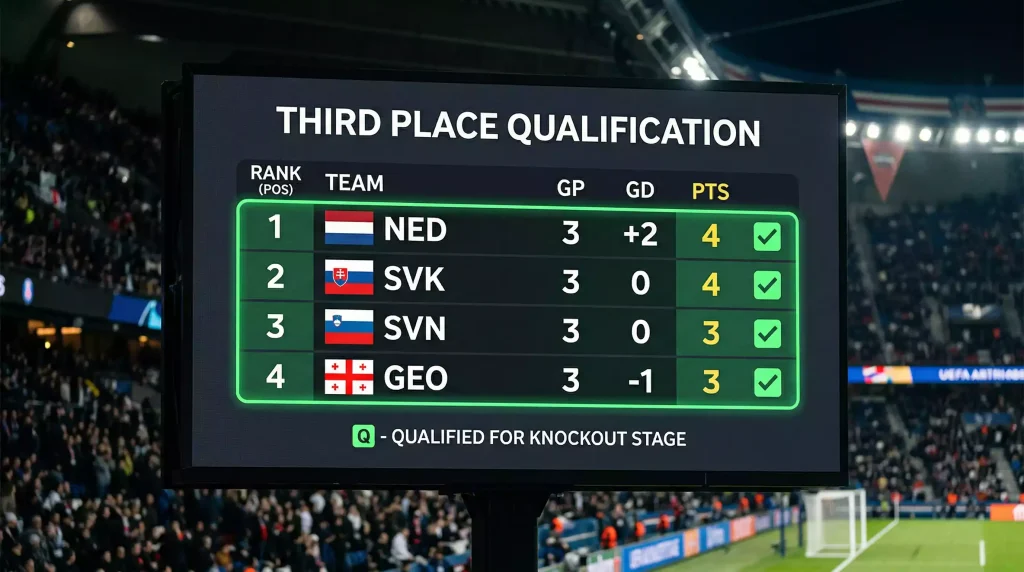
Table of Contents
Portugal scraped through as a best third-place team at Euro 2016 and won the entire tournament. That pathway – surviving group stage elimination through mathematical permutation rather than dominant performance – proved that finishing third doesn’t condemn teams to also-ran status. The World Cup 2026 format introduces this mechanism to FIFA’s flagship tournament for the first time, and understanding exactly how it works matters enormously for betting. Eight of twelve third-place teams will advance to the Round of 32. The difference between qualifying third-place and eliminated third-place could be a single goal, a yellow card accumulation, or head-to-head result from an earlier match. Here’s the complete breakdown.
The 48-Team Format Explained
FIFA expanded the World Cup from 32 to 48 teams for 2026, the first format change since 1998 added the Round of 16 structure that became familiar over subsequent tournaments. The expansion serves multiple purposes: broader global participation, increased revenue through additional matches, and qualification pathways for confederations previously limited to handful of spots. Whether it improves the tournament as a spectacle remains debatable – more matches also means more mismatches – but the format is locked for 2026 and likely permanent.
Forty-eight teams divide into twelve groups of four. Each team plays three group matches, producing 36 points and significant goal difference variation across groups. The top two teams from each group advance automatically – that’s 24 teams guaranteed progression. An additional eight slots go to the best third-place finishers across all twelve groups, creating the Round of 32 that precedes the traditional Round of 16.
The Round of 32 represents an entirely new knockout stage. Previous World Cups jumped directly from group play to knockout rounds featuring 16 teams. Now, 32 teams survive the group stage, meaning two-thirds of the tournament field advances rather than half. This structural change affects strategy throughout – teams can finish third and still have realistic tournament ambitions, while group winners face fourth-place-eliminated teams from other groups who had nothing left to lose.
Match scheduling concentrates group stage play into 17 days – June 11 through June 27, 2026. The Round of 32 runs June 28 through July 2, the Round of 16 from July 3 through July 6, quarter-finals July 9-11, semi-finals July 14-15, and the final July 19 at MetLife Stadium. Teams reaching the final play eight matches across 39 days – more games with tighter scheduling than any previous World Cup demanded.
The geographic distribution matters for practical logistics but doesn’t affect qualification mathematics. Matches spread across 16 venues in three countries (USA, Mexico, Canada), with travel distances varying considerably. Teams based in Western US venues face different schedules than those playing in Eastern Canada or Mexico City. These factors influence fatigue and form but don’t change how third-place qualification calculates.
How Third Place Qualification Works
Eight of twelve third-place teams qualify. The selection process ranks all third-place finishers using standard World Cup tiebreaker criteria, then advances the top eight. Understanding this ranking system determines how aggressively teams should play when third place becomes their realistic ceiling.
The primary ranking criterion is points. A third-place team with four points (one win, one draw) ranks above a third-place team with three points (one win, two losses) regardless of other factors. Since each team plays three matches with maximum nine points available, third-place teams typically finish with one to four points. Teams on zero points almost certainly fail to qualify; teams on four or more points almost certainly advance.
Goal difference breaks ties when third-place teams finish level on points. This is where betting strategy becomes interesting. A team sitting on three points with +1 goal difference ranks above a team on three points with -1 goal difference. Final group matches therefore carry dual significance: results that determine finishing position and goals that determine goal difference for ranking purposes.
Goals scored provides the next tiebreaker after goal difference. A team on three points with goal difference of +1 (scored 4, conceded 3) ranks above a team on three points with goal difference of +1 (scored 2, conceded 1). This rewards attacking play and discourages conservative 1-0 results when goal difference is already level.
Fair play points – yellow and red card accumulations – serve as the final tiebreaker before lots are drawn. This rarely decides major outcomes but has occurred in previous tournaments. Teams receive penalty points for bookings: one point per yellow card, three points per red card or second yellow. Lower totals rank higher. I’ve seen this tiebreaker decide continental championship qualifications and wouldn’t dismiss its relevance for closely-matched World Cup groups.
The practical application creates strategic complexity. If a team secures third place before their final group match but could still improve their goal difference, they should attack rather than defend. If a team faces elimination regardless of result, they have nothing to lose – creating unpredictable dynamics for opponents counting on routine victories. Betting on final group matches requires understanding not just what each team needs but what their opponents need and how those incentives interact.
Tiebreaker Rules
Within groups, tiebreakers operate differently than across third-place rankings. Understanding both systems prevents confusion when final group standings produce unexpectedly complex scenarios.
Group tiebreakers between teams level on points apply in this sequence: points in head-to-head matches, goal difference in head-to-head matches, goals scored in head-to-head matches, then overall goal difference, overall goals scored, fair play conduct, and finally lots drawn. The head-to-head priority matters because two teams on equal points played each other during group stage – that direct result carries more weight than accumulated statistics.
When three or more teams finish level on points in a group, head-to-head becomes more complex. You create a mini-table using only matches between the tied teams, then apply the tiebreaker sequence to that mini-table. If teams remain level after head-to-head mini-tables, overall tournament statistics resolve the tie.
Third-place rankings across groups cannot use head-to-head because those teams didn’t play each other. The ranking sequence is therefore simpler: points, goal difference, goals scored, fair play, lots. But the simplicity creates difficulty because 12 teams could theoretically finish with identical points and similar goal differences.
Projecting third-place qualification requires modelling outcomes across all twelve groups simultaneously. A team finishing third in Group D with three points and +2 goal difference might qualify comfortably in one scenario where other groups produce lower third-place totals, but face elimination in another scenario where strong groups produce four-point third-place finishers throughout. This uncertainty complicates betting on specific third-place outcomes until late group stage when other groups have resolved.
The lots tiebreaker – random drawing when all other criteria fail to separate teams – hasn’t been needed at a major tournament since fair play was introduced as the penultimate criterion. But FIFA retains it as a final resolution mechanism. If drawn, lots would determine qualification through pure chance rather than footballing merit. The possibility, however remote, injects variance into what should be mathematically determined outcomes.
Historical Context
Third-place qualification debuted at World Cups in 1986, when the tournament expanded from 24 to 32 teams before quickly reverting to a different format. That tournament and subsequent editions used 24-team structures with six groups of four, advancing two teams per group plus the four best third-place finishers. The 2026 format applies similar logic to twelve groups with eight advancing.
The European Championship provides the closest template for how modern third-place qualification operates. Euro 2016 and 2020 both used 24 teams in six groups, advancing the four best third-place finishers alongside 12 automatic qualifiers. Portugal’s 2016 triumph via third-place advancement demonstrates the pathway’s legitimacy – they finished third in a group containing Hungary, Iceland, and Austria, then won every knockout match to lift the trophy.
At Euro 2016, Portugal accumulated three draws for three points and goal difference of zero. They ranked third among third-place finishers, qualifying despite failing to win a group stage match. Their subsequent knockout run included wins over Croatia, Poland, Wales, and France – increasingly impressive scalps that retroactively justified their survival. The lesson: third-place qualification doesn’t indicate weakness; it indicates survival through a competitive group that distributed points unpredictably.
Euro 2020 produced different third-place dynamics. Switzerland finished third behind Italy and Wales but qualified with four points – more than some second-place finishers in other groups. They then defeated France on penalties in the Round of 16, demonstrating that third-place teams can immediately threaten traditional powerhouses. Ukraine also advanced via third place and reached the quarter-finals.
The 2026 World Cup expands this mechanism to unprecedented scale. Eight third-place teams from twelve groups doubles the complexity of Euro qualifying scenarios. More teams mean more variation in third-place point totals, potentially ranging from zero to six points depending on group competitiveness. Historical patterns suggest that three points will typically suffice for qualification, while four points guarantees advancement. Teams finishing on one or two points enter mathematical purgatory where goal difference determines fate.
What This Means for Australia
Australia enters Group D as underdogs against the USA, competitive with Türkiye, and favoured against Paraguay based on recent form and squad quality. The realistic target is third place with enough points to secure Round of 32 qualification. Understanding how third-place advancement works shapes strategic approach across all three group matches.
The opening match against Türkiye carries outsize importance beyond the three points available. If Australia win, they establish goal difference advantage and pressure Türkiye – the primary competitor for third place – into must-win situations. A draw keeps Australia level with Türkiye while preserving positioning options. A loss places Australia in difficult territory requiring results against the USA and Paraguay that may prove difficult to achieve.
The USA match presents realistic upset potential but more likely a loss for Australia. Historical patterns suggest the Socceroos will compete harder than odds indicate – they took Argentina to 2-1 at Qatar 2022 – but the USA’s home advantage and squad quality tilts probability decisively. The betting approach here focuses on smaller markets: Australia to score, over/under goals, half-time results where Australia might lead before succumbing to American pressure. The match result matters for points but goal difference management matters equally.
Paraguay in the final group match could determine Australian advancement. If Australia enter that match needing a result for third-place qualification, Paraguay might already be eliminated and playing for pride rather than stakes. Alternatively, Paraguay could need a result themselves, creating a competitive encounter. The scenario uncertainty means this match’s betting value depends on previous results – I’m not pre-committing to positions until context clarifies.
The broader implication: Australia should target three points minimum, with four points representing comfortable qualification territory. Three points with positive goal difference almost certainly advances. Three points with negative goal difference creates anxiety that other groups’ results determine. Two points requires favourable results elsewhere and likely fails. I’m building my Australia betting around these thresholds – back Australia to qualify at 2.80+, structure match bets around accumulating the points needed rather than hoping for group dominance.
For comprehensive coverage of Australia’s tournament prospects including squad analysis and match-by-match betting strategy, check the complete World Cup 2026 groups overview.
