
MetLife Stadium: World Cup 2026 Final Venue Guide
 Available in US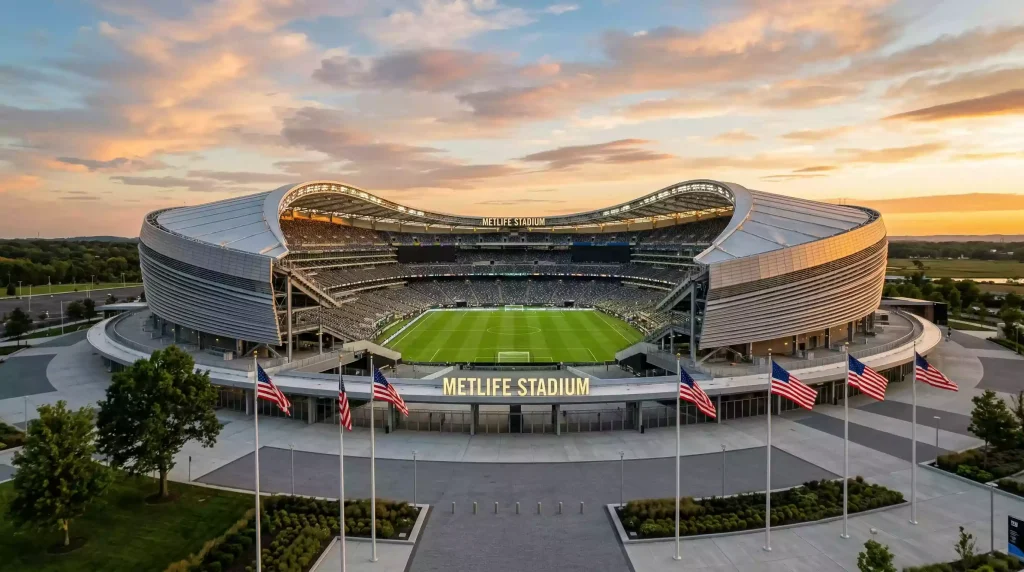
Table of Contents
July 19, 2026. MetLife Stadium. East Rutherford, New Jersey. The FIFA World Cup Final. These words will define football’s biggest single sporting event, watched by an estimated two billion people worldwide. For Australian punters who’ve followed the Socceroos through Group D and beyond, this venue represents either the ultimate destination or the backdrop for rivals lifting the trophy we hoped might be ours.
MetLife Stadium wasn’t the obvious choice for football’s grandest occasion. It lacks the architectural romance of Maracanã or the historical weight of Wembley. What it offers instead is American pragmatism — 82,500 seats with excellent sightlines, world-class facilities, and proximity to New York City’s global media infrastructure. The venue has hosted Super Bowls, WrestleManias, and countless NFL games. Now it adds the World Cup Final to a resume that already includes international football matches drawing massive crowds.
About MetLife Stadium
Opened in 2010, MetLife Stadium replaced the beloved Giants Stadium that had served New York football since 1976. The construction cost exceeded $1.6 billion, making it among the most expensive sports venues ever built. Unlike many American stadiums that prioritise enclosed environments with retractable roofs, MetLife embraces the elements — an open-air design that connects players and fans to the atmosphere in ways climate-controlled venues cannot replicate.
The stadium serves as home to both the New York Giants and New York Jets, a rare sharing arrangement in American professional sports. This dual tenancy means the venue operates almost year-round, with infrastructure maintained to standards that World Cup organisers require. The pitch itself receives extensive preparation for football matches, with NFL field markings removed and grass surfaces cultivated specifically for the sport.
Capacity expands for World Cup matches through temporary seating configurations. The standard 82,500 capacity can stretch beyond 87,000 for championship events, with the Final likely seeing maximum attendance. Every seat provides unobstructed views thanks to the bowl design’s gentle rake, and the proximity of lower sections to the pitch creates atmosphere that larger venues sometimes sacrifice for capacity.
Facilities exceed typical football stadium standards. Concourses span multiple levels with varied food and beverage options, restroom queues move efficiently due to generous provisioning, and cellular connectivity has been upgraded specifically for World Cup crowds expecting to share moments instantly. The venue’s experience has improved considerably since early years when operational challenges frustrated attendees.
World Cup 2026 Matches
MetLife Stadium hosts eight matches across the tournament, culminating in the July 19 Final that represents football’s pinnacle. The venue’s assignment reflects FIFA’s confidence in American infrastructure and New York’s global profile. Beyond the Final, MetLife hosts both semi-finals (July 14 and 15), a quarter-final, and four group stage matches — ensuring the stadium remains central to tournament narrative from opening week through championship conclusion.
The group stage matches assigned to MetLife feature some of the tournament’s headline attractions. Argentina plays here during group stages, bringing Lionel Messi to New York’s doorstep for potentially his final World Cup appearance. England’s group stage presence adds Premier League familiarity that resonates with American audiences increasingly engaged with European football. These assignments guarantee packed houses before knockout rounds even begin.
For Australian viewers, the AEST timing of MetLife matches creates mixed convenience. Semi-finals and the Final fall overnight in Australia — approximately 6:00-10:00 AEST depending on local kickoff times. Group stage matches offer slightly better windows, with morning kickoffs translating to late evening Australian viewing. Regardless of timing, the matches warrant watching; MetLife’s atmosphere for knockout rounds should prove electric.
The venue’s World Cup preparation began years before the tournament. Pitch dimensions have been adjusted to meet FIFA specifications, broadcast infrastructure expanded to accommodate global television requirements, and security protocols developed in coordination with American federal agencies. MetLife enters the tournament as one of the world’s most operationally ready venues.
The Final: July 19, 2026
The World Cup Final represents the single biggest event in MetLife Stadium’s history — and arguably the biggest sporting event ever held in the New York metropolitan area. Two nations will contest 90-plus minutes that define football immortality, watched by a global audience that dwarfs Super Bowl viewership. The stakes create pressure that transforms even experienced players; the setting ensures every moment carries historical weight.
Kickoff timing will balance global broadcast considerations. European prime time, South American afternoon, and American daytime create competing interests that FIFA navigates through compromise. Expect a 4:00 PM local kickoff (6:00 AM AEST Monday morning), though exact timing confirms closer to the tournament. Australian viewers prepared for early alarms will witness football history as it unfolds.
The Final’s betting markets encompass everything from match winner to individual player propositions. Outright tournament winner markets effectively close at kickoff, while match-specific markets offer final opportunities for the World Cup’s biggest single betting event. The sheer concentration of global betting activity creates liquidity that produces tight spreads and efficient pricing.
Atmosphere inside MetLife for the Final should prove extraordinary. American sporting culture embraces championship moments with intensity that rivals any footballing nation, and the New York metropolitan area’s diverse population ensures both finalists receive passionate support. The venue’s open-air design means weather becomes a factor — July in New Jersey offers warmth and potential humidity that affects playing conditions.
Capacity & Atmosphere
MetLife’s 82,500 standard capacity expands for major events, with the World Cup Final likely accommodating approximately 87,000 spectators. This makes it one of the tournament’s largest venues, exceeded only by Estadio Azteca in Mexico City and potentially SoFi Stadium in Los Angeles depending on configuration. Size creates atmosphere when passionate fans fill seats; MetLife’s design channels noise effectively despite open-air construction.
The bowl structure places spectators closer to action than many purpose-built football stadiums. Lower deck seats at MetLife sit nearer the pitch than comparable sections at venues designed with athletics tracks separating stands from playing surface. This proximity intensifies atmosphere, connecting players and fans in ways that larger, more separated venues cannot replicate.
American crowds approach football differently than traditional footballing nations. The supporter culture emphasises enthusiasm over organised chanting, creating walls of noise rather than coordinated songs. For World Cup matches featuring passionate footballing nations like Argentina or England, expect those supporters to dominate acoustic territory while American neutrals add ambient energy. The resulting atmosphere should prove globally broadcast-friendly.
Corporate hospitality comprises significant capacity allocation, as with all major American sporting events. Premium seating includes climate-controlled suites, club level access with enhanced amenities, and field-level sections that place guests remarkably close to players. World Cup Final hospitality packages command premium prices that reflect once-in-lifetime positioning for football’s biggest match.
Location & Access
MetLife Stadium sits in East Rutherford, New Jersey — approximately 13 kilometres from Manhattan’s centre. Despite its “New York” team associations, the venue technically resides in a different state, creating jurisdictional quirks that affect everything from taxation to public transit coordination. The location prioritises parking accessibility over urban integration, reflecting American stadium development patterns.
Public transit options include NJ Transit rail service to Meadowlands station, directly adjacent to the stadium. During major events, enhanced service provides direct connections from Penn Station in Manhattan, with journey times around 30 minutes depending on train schedules. This rail connection proves essential for World Cup matches, as parking demand far exceeds on-site capacity for championship fixtures.
For visitors traveling from Australian time zones, the journey involves flying into Newark Liberty International Airport (closest), JFK International Airport, or LaGuardia Airport. Newark offers the most convenient MetLife access, with rail connections available directly from the airport terminal. Accommodation in Manhattan provides the widest entertainment options, though Hoboken and Jersey City offer closer alternatives with excellent transit links.
Match day logistics require planning that accounts for American security screening procedures. Arrive early — two hours before kickoff for group matches, three hours for knockout rounds, even earlier for the Final. Clear bag policies, prohibited item lists, and gate assignment awareness all affect entry efficiency. MetLife’s operational experience with large crowds helps, but World Cup matches attract different audiences than NFL regulars accustomed to procedures.
Stadium History
MetLife Stadium’s football heritage predates its construction through Giants Stadium, the predecessor venue that hosted Copa América 2016 and numerous international friendlies. That earlier stadium saw football crowds exceed 79,000 for matches involving Barcelona, Manchester United, and other European giants touring American summers. MetLife inherited and expanded that international football programming.
The venue’s most significant football moment before World Cup 2026 came during the 2016 Copa América Centenario final, when Chile defeated Argentina on penalties to claim the continental championship. That match demonstrated MetLife’s capability to host football’s elite — and foreshadowed the World Cup assignment that followed. Argentina’s Lionel Messi missed a penalty that night; he’ll return seeking different memories in 2026.
NFL history dominates the venue’s narrative, with two Super Bowls (XLVIII in 2014), countless playoff games, and regular season fixtures that draw 80,000+ weekly. This operational intensity means MetLife staff possess experience managing massive crowds that football-specific venues, used to fewer annual events, cannot match. The World Cup benefits from this accumulated institutional knowledge.
Beyond football, MetLife has hosted Pope Francis’s mass in 2015, WrestleMania 29 and 35, U2 and Coldplay concerts, and international rugby matches. This versatility demonstrates the venue’s adaptability to different event requirements — a characteristic that World Cup organisers valued during site selection. MetLife has proven it can handle whatever demands event organisers impose.
For complete tournament coverage including betting odds, team analysis, and match predictions, visit our World Cup 2026 betting hub.
