
The Complete World Cup 2026 Betting Guide
 Available in US
Table of Contents
Eight years ago, I backed Germany at 7.00 to win the 2014 World Cup. That single wager paid for a trip to watch the semi-finals in Brazil. Five months from now, 48 nations will compete across three countries in the largest FIFA tournament ever staged, and the betting landscape has never been more complex or more rewarding for those who understand it. This World Cup 2026 betting guide distills everything I have learned from covering four consecutive tournaments into a practical framework you can apply whether you are placing your first punt or your five-hundredth.
Australia occupies a fascinating position for this World Cup. The Socceroos landed in Group D alongside hosts USA, Türkiye, and Paraguay — arguably the toughest draw among all three host groups. With matches kicking off at civilised hours in AEST (most games fall between 05:00 and 15:00 local time), Australian punters can actually watch live and react, unlike the European tournaments that force us into 3am alarms. Add in SBS broadcasting all 104 matches free-to-air, and we have unprecedented access to inform our betting decisions.
The expansion from 32 to 48 teams fundamentally changes how I approach World Cup betting. More matches mean more opportunities, but also more variance. Third-place finishes now matter because eight of the twelve third-placed teams advance to the Round of 32. This single rule change creates value in markets that bookmakers are still learning to price correctly. Throughout this guide, I will show you exactly where those edges exist and how to exploit them before the market catches up.
TL;DR: Betting Essentials
If you read nothing else, absorb these five principles that separate profitable World Cup punters from the recreational crowd. First, the 48-team format creates structural value in group qualification markets because third place has genuine utility — historically priced as worthless, now worth backing in tight groups. Second, decimal odds of 2.50 mean you need a 40% probability to break even, not 50% — learn to calculate implied probability or you are flying blind. Third, Asian handicaps eliminate the draw and often offer superior value to traditional match betting, particularly when a favourite faces a defensive underdog. Fourth, bankroll management matters more in tournament betting because you cannot recover from early losses the way you can across a season. Fifth, timing your bets correctly can add 10-15% to your returns, with outright markets typically offering best value 2-4 weeks before kickoff and match odds tightening in the final 48 hours.
The Australian legal framework permits online sports betting through licensed operators, but in-play wagering via internet is prohibited — you must use telephone betting for live markets. This restriction actually creates opportunity because casual punters avoid phone betting, leaving less competition for line movements during matches. Every bookmaker operating legally in Australia holds a license, primarily through Northern Territory, and must offer self-exclusion through BetStop if you need to manage your gambling. The new advertising restrictions taking effect from January 2027 will dramatically reduce promotional bombardment, but for this World Cup, expect aggressive sign-up offers that can provide starting bankroll boosts if used wisely.
Understanding the 48-Team Format
When FIFA announced the expansion, my first thought was dilution — more minnows, more predictable outcomes, less drama. I was wrong. The new format actually increases competitive matches because every group game carries qualification implications, and the eight best third-placed teams advancing creates scenarios where nations playing for a draw still have something tangible at stake. Understanding this structure is fundamental to identifying betting value throughout the tournament.
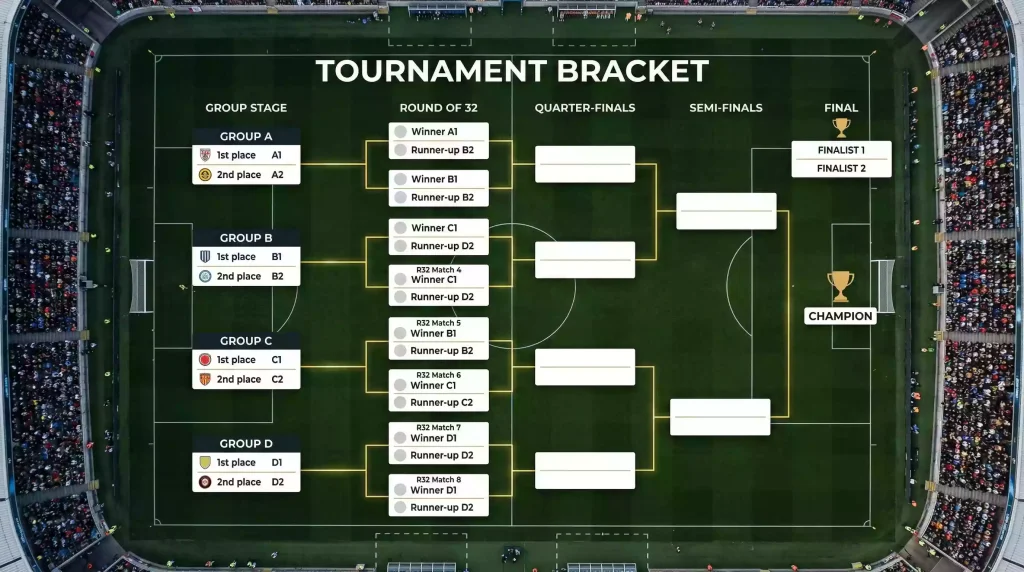
The mathematics work like this: 48 teams divided into 12 groups of four, with the top two from each group plus eight best third-placed finishers progressing to a Round of 32. That means 32 teams advance from 48, a qualification rate of 67%. Compare this to the previous 32-team format where 16 from 32 advanced (50%), and you see why even modest performances can secure knockout football. For betting purposes, this raises the floor for weaker nations and compresses the gap between qualification probability across group positions.
The tournament runs from 11 June to 19 July 2026 — 39 days and 104 matches. The opening fixture sees Mexico hosting South Africa at Estadio Azteca in Mexico City, while the final takes place at MetLife Stadium in New York. Group stages run from 11-27 June, giving punters 16 days of simultaneous action before the bracket crystallises. The sheer volume of matches creates fatigue in casual bettors, which historically leads to sharper odds in the second week of group play when public attention fragments.
Third-place qualification deserves particular attention because bookmakers historically undervalue these scenarios. The eight best third-placed teams advance, ranked by points, then goal difference, then goals scored. In groups where the top two spots seem locked (think Argentina in Group J, or France in Group I), the battle for third becomes the competitive fulcrum. Nations like Austria (Group J), Norway (Group I), or Panama (Group L) have genuine paths to the knockout rounds despite facing elite opposition. Markets pricing these teams at long odds for “group stage exit” often misprice the mathematical reality of 67% group advancement.
The three-host structure creates unique travel dynamics that impact team performance and, consequently, betting outcomes. Teams based primarily in the USA enjoy consistent conditions, while those bouncing between Mexico City altitude (2,240 metres), Vancouver’s temperate climate, and Miami’s humidity face physical adjustments. Argentina, England, and Brazil have all drawn groups that keep them within the USA, avoiding altitude complications entirely. Meanwhile, Group A (Mexico, South Korea, South Africa, Czechia) plays exclusively in Mexican venues — the altitude factor cannot be ignored when assessing over/under totals and stamina-dependent handicaps.
Betting Markets Explained
A punter once asked me why I spend hours analysing Asian handicaps when he could just pick a winner. Three months later, his World Cup bankroll was gone, and mine had grown 40%. The difference was not prediction accuracy — it was market selection. Choosing the right market for each bet is as important as choosing the right outcome, and the 2026 World Cup offers more market diversity than any previous tournament.
Outright Markets
Outright markets lock your stake until tournament completion but offer the highest potential returns. The primary outright bet is tournament winner, where Argentina currently sits around 4.50 (implied probability 22%), France at 5.50 (18%), England at 7.00 (14%), and Brazil at 8.00 (12.5%). These odds reflect a competitive top tier with no dominant favourite, unlike 2014 when Brazil opened at 3.00 or 2010 when Spain was 5.00 before their victorious campaign.
Group winner markets price each nation’s chances of topping their group — valuable for teams like Spain (Group H) who face Uruguay but should control their destiny, or Germany (Group E) whose path looks clearest among contenders. To reach the final markets split the tournament at the semi-final stage, offering better prices for teams in tougher brackets. Top goalscorer (Golden Boot) typically rewards strikers from nations likely to reach the latter stages, with Kylian Mbappé and Harry Kane usually heading the market.
The value in outright markets often lies in the middle tier — nations priced between 25.00 and 50.00 who have genuine knockout-stage upset potential. Morocco’s 2022 run to the semi-finals returned massive profits for those who identified their defensive solidity and favourable bracket positioning. For 2026, look at teams like the Netherlands (strong group, experienced squad), Colombia (underrated attacking quality), or even Türkiye (motivated after 24-year World Cup absence) for similar profiles.
Match Markets
Match result (1X2) remains the most popular market globally, offering three outcomes: home win, draw, or away win. At World Cups, “home” and “away” become nominal designations, though host nations do receive genuine home advantage — USA’s matches will carry American-majority crowds throughout their Group D campaign. The draw outcome typically ranges from 3.00 to 4.00 depending on the matchup, and World Cups historically produce around 20-25% draws in group stages, rising to 15-20% in knockouts (where extra time eventually breaks deadlocks).
Double chance markets combine two outcomes (home or draw, away or draw, home or away) and suit scenarios where you have directional conviction but want insurance. Backing “Australia or draw” against USA might return 2.80 compared to 5.00 for an outright Socceroos victory — you sacrifice upside for probability. Draw no bet removes the draw entirely, refunding your stake if teams finish level; this market sits between double chance and match result in both risk and reward.
Both teams to score (BTTS) and total goals (over/under) focus on game flow rather than winner. BTTS yes typically prices around 1.75-2.00 and rewards attacking matchups or defensively suspect sides. Over/under 2.5 goals is the standard line, with over generally priced around 1.85-2.10 and under at 1.80-1.95 depending on the matchup. Group stage averages historically sit around 2.4 goals per game, rising slightly in knockouts where desperation creates open play.
Player Props
Player proposition markets let you bet on individual performances independent of match outcome. Anytime goalscorer is the most liquid, pricing each player’s chance of scoring at least once; favourites in strong attacking teams (Mbappé, Haaland, Vinícius Jr) typically sit around 2.20-2.80, while defenders might offer 15.00 or higher. First goalscorer carries higher variance but better prices — usually around 5x the anytime odds for equivalent probability.
Cards markets (player to be booked) suit defensive midfielders and aggressive full-backs. At the 2022 World Cup, I profited consistently backing booking points for players facing rapid wingers — the foul count rises when pace mismatches occur. Shot markets (over/under player shots) reward attackers with high volume regardless of finishing quality, while assist props favour creative players in possession-dominant sides.
For Australian punters specifically, the Socceroos’ player markets offer local knowledge advantages. If you follow the A-League and understand which players handle pressure, which tire in high-intensity matches, and which have been in form during the domestic season, you possess an information edge over international bookmakers pricing these lines. Nestory Irankunda’s breakthrough performances or Jackson Irvine’s set-piece threat might be undervalued in player markets set by analysts who focus primarily on European leagues.
Asian Handicaps and Totals
Asian handicaps eliminate the draw by applying a goal start or deficit to one team. If you back USA -0.5 against Australia, the Americans must win outright for your bet to succeed — a draw loses. This seems straightforward, but the beauty lies in split handicaps: backing Australia +0.75 means half your stake goes on +0.5 (lose if USA wins by 2+, refund on USA win by 1, win on draw or Socceroos victory) and half on +1.0 (win if Australia loses by exactly 1, or better). The granularity lets you fine-tune your position with precision impossible in traditional markets.
Asian totals work identically to Asian handicaps but for goals. Over 2.25 goals splits your stake between over 2.0 (refund at exactly 2 goals, win at 3+) and over 2.5 (lose at 2 or fewer, win at 3+). If a match finishes 2-0, you lose half your stake (the 2.5 portion) but recover the other half (the 2.0 portion). This mechanism reduces variance compared to standard over/under markets where a single goal either side of the line determines total profit or loss.
The real edge in Asian markets comes from reduced bookmaker margins. A typical 1X2 market might carry a 106-108% overround (the bookmaker’s margin), while equivalent Asian handicap markets often sit at 102-104%. Over hundreds of bets, this 3-4% difference compounds significantly. Additionally, Asian lines react faster to team news because the markets attract sharper money, meaning early access to injury or lineup information provides exploitable windows before prices adjust.
How to Read Decimal Odds
A friend once told me he “understood” odds because bigger numbers meant less likely. He was technically correct but practically useless — without converting odds to probability, you cannot assess whether a price offers value. Decimal odds, standard across Australia, tell you your total return per dollar staked. Odds of 3.00 mean a $10 stake returns $30 total ($20 profit plus your $10 stake). Simple enough, but the real skill lies in working backwards.
To convert decimal odds to implied probability, divide 100 by the odds. Odds of 2.00 imply 100/2.00 = 50% probability. Odds of 4.00 imply 100/4.00 = 25% probability. Odds of 1.50 imply 100/1.50 = 66.67% probability. Memorise these benchmarks: 2.00 = 50%, 3.00 = 33%, 4.00 = 25%, 5.00 = 20%, 10.00 = 10%. Any quick mental calculation can then adjust from these anchor points.
Value exists when your assessed probability exceeds the implied probability. If you believe Australia has a 30% chance against Türkiye and the Socceroos are priced at 4.00 (implied 25%), backing Australia offers positive expected value. Conversely, if Argentina sits at 1.40 to beat Jordan (implied 71%) but you assess their true chances at 75%, the margin is too thin to justify the juice. This framework removes emotion from betting decisions and forces quantitative evaluation of every wager.
The bookmaker’s margin (overround) inflates the sum of all implied probabilities beyond 100%. In a three-outcome match market, true probabilities sum to 100%, but bookmaker-adjusted probabilities might sum to 106%. That extra 6% is their profit margin, extracted proportionally from each outcome’s price. When comparing bookmakers, calculate the overround by summing implied probabilities — lower overrounds mean better value for punters. A market with 102% overround returns more to bettors long-term than one at 108%, even if individual prices appear similar.
For Australians accustomed to tote odds at the track, decimal odds feel natural, but beware fractional odds if betting with UK-facing sites. Fractional 5/2 equals decimal 3.50 (you win $5 for every $2 staked, plus your stake). The conversion formula: add 1 to the fractional top/bottom division. So 5/2 = (5÷2) + 1 = 2.5 + 1 = 3.50. American odds (+200 means $100 profit on $100 stake, -150 means $150 stake to profit $100) rarely appear in Australian markets but occasionally surface on US-centric props for this tournament.
Finding Value: The Punter’s Edge
I lost money in my first two World Cups despite picking winners at a respectable rate. The problem was not accuracy — it was backing short-priced favourites and collecting 1.50 when I needed 1.80 to profit long-term. Value betting transformed my approach: instead of asking “who will win?” I ask “where do the odds underestimate probability?” This shift changes everything.
Expected value (EV) quantifies whether a bet is mathematically sound. The formula is straightforward: (Probability of Winning × Profit if Win) – (Probability of Losing × Stake). If you believe Australia has a 25% chance to beat USA and the odds are 5.00 (returning $40 profit on a $10 stake), EV = (0.25 × $40) – (0.75 × $10) = $10 – $7.50 = +$2.50. A positive EV means the bet is theoretically profitable long-term, regardless of individual outcomes.
Finding value requires independent probability assessment before looking at odds. I watch footage, analyse statistics, and form an opinion, then compare to market prices. If you look at odds first, anchoring bias corrupts your judgment — you unconsciously adjust toward the quoted price. Force yourself to write down “I think Team A has X% chance” before ever opening a bookmaker’s app, and you will make more objective evaluations.
Market inefficiencies at World Cups cluster in predictable areas. First, teams from non-European confederations get undervalued because European-focused analysts lack deep knowledge of AFC, CONMEBOL, or CAF sides. Japan’s victories over Germany and Spain in 2022 came at prices reflecting bookmaker ignorance, not low quality. Second, third-place scenarios remain mispriced because recreational punters focus on group winners and ignore the mathematical pathways to knockout rounds via third. Third, player props for non-superstar attackers often carry soft lines because liquidity concentrates on headline names like Mbappé or Kane.
Discipline separates value bettors from losers chasing action. A genuine value opportunity might appear once every five matches, meaning you skip the others entirely. This patience feels counterintuitive during a World Cup when every game tempts involvement, but forcing bets on neutral markets erodes bankroll faster than selectivity builds it. I keep a running spreadsheet of “bets I considered but passed on” — reviewing these decisions post-tournament consistently validates the discipline.
Bankroll Management for Tournament Betting
The 2018 World Cup taught me an expensive lesson. I started strong, grew overconfident, increased stakes, hit variance, and finished below my starting point despite a 55% win rate. Tournament betting compresses 39 days of action into a format where early losses cannot be recovered through volume like a regular season allows. Bankroll management is not optional — it is survival.
Allocate a fixed tournament bankroll before the World Cup begins and divide it into units. If your total budget is $1,000, each unit might be $20 (2% of bankroll) or $10 (1%). The percentage depends on your risk tolerance, but staying between 1-3% per bet ensures that even a losing streak cannot eliminate you. Flat staking (same amount every bet) suits most punters; Kelly criterion staking (varying size based on edge magnitude) offers theoretical optimisation but requires accurate probability assessment that most bettors overestimate their ability to deliver.
Never chase losses by increasing stakes. This principle sounds obvious but becomes incredibly difficult when you are down after day two and 30+ matches remain. The temptation to double up and “get even” leads to accelerated ruin. Conversely, do not dramatically increase stakes during winning streaks — variance works both directions, and yesterday’s profits can evaporate if you suddenly bet 5x your standard unit on a “lock” that loses.
Separate your betting bankroll from everyday finances. This psychological firewall prevents desperation plays and clarifies true position. If your bankroll depletes completely, you stop — no dipping into savings, no “just this once” exceptions. Professional punters treat bankroll as business capital, not entertainment money, and this framing promotes rational decision-making even during emotional swings.
For the 2026 World Cup specifically, I recommend front-loading outright bets (tournament winner, group winners, top goalscorer) before group stages begin, allocating perhaps 20-30% of bankroll to these positions. The remaining 70-80% funds match-by-match bets throughout the tournament, sized to ensure you have stake available through the semi-finals even if the group stage goes poorly. Running out of ammunition before knockout rounds wastes weeks of analysis on matches you cannot exploit.
When to Place Your Bets
Timing a bet correctly can add 10-15% to returns without improving selection accuracy at all. I learned this watching Argentina’s outright odds drift from 4.00 six weeks before the 2022 World Cup to 5.50 on the eve of the tournament (injury concerns to Dybala and Lo Celso), then shorten dramatically to 3.00 by the quarter-finals. The same bet at different times returned vastly different amounts — and I could have backed them pre-tournament at superior value.
Outright markets typically offer best value 2-4 weeks before tournament kickoff. Prices have stabilised from qualification volatility but have not yet attracted the massive recreational money that floods in during the final week. For World Cup 2026, that sweet spot falls in late May — close enough that squad selections are confirmed, far enough that bookmakers are not yet reacting to minute-by-minute news cycles.
Match odds tighten in the final 48 hours as market consensus solidifies and bookmakers reduce margins to attract volume. If you have an information edge (local knowledge of team form, injury whispers, travel fatigue patterns), exploit it early before the market catches up. If you are following the herd, waiting for team sheets (released one hour before kickoff) provides maximum information but minimum value — odds barely move after lineups confirm what insiders already knew.
Live betting (in-play) requires telephone calls under Australian law, creating friction that actually benefits patient punters. Prices move slower on Australian phone lines than on international in-play platforms because operators manually update rather than algorithmically adjusting in milliseconds. If you can identify moments of mispricing — a goal that does not change underlying match dynamics, a red card that affects less than odds suggest — phone betting provides windows to exploit before prices correct.
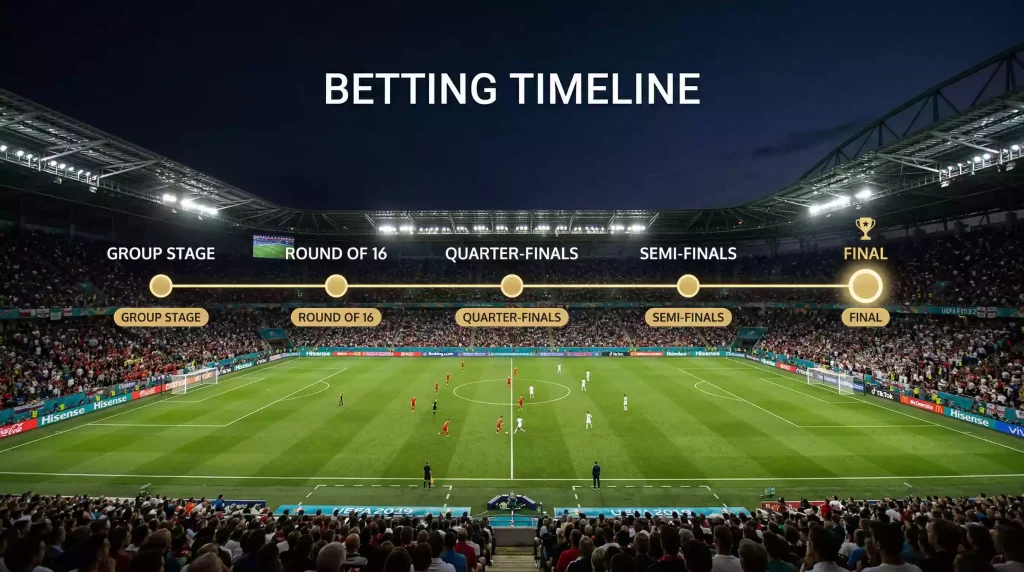
Group stage progression creates cascading effects on knockout odds. After the Round of 32 bracket crystallises, paths to the final become concrete, and teams in favourable draws see outright odds shorten while those facing early contenders drift. Smart punters track bracket implications throughout group play and position before markets react. If you spot that Argentina will face a weak Round of 32 opponent regardless of Group J finishing position, their odds immediately after group stage completion will be worse than before the bracket is drawn.
Betting in Australia: Legal Framework
Australian punters operate in one of the most regulated sports betting environments globally, and understanding the rules is not just about compliance — it affects which strategies are legally available to you. The Interactive Gambling Act 2001 permits online sports betting through licensed operators while prohibiting online casino games and in-play internet wagering. This means you can bet on the World Cup through any Australian-licensed bookmaker, but live bets during matches require phone calls.
Every legal bookmaker in Australia holds a license, primarily issued through the Northern Territory, and must comply with consumer protection requirements including responsible gambling messaging, deposit limits, and access to BetStop — the national self-exclusion register that blocks you from all licensed operators simultaneously if you choose to register. These protections exist because Australians bet more per capita than almost any other nationality; roughly 11% of adults engage in online gambling, and the government rightly prioritises harm minimisation.
Advertising reforms taking effect from January 2027 will transform how bookmakers market to Australians, but for the 2026 World Cup, expect aggressive promotional activity. Sign-up bonuses, deposit matches, and enhanced odds offers will flood the market during June-July 2026. These promotions can boost starting bankroll if used strategically — but read terms carefully. Most bonuses require turnover multiples before withdrawal, meaning a “free $200 bonus” often needs $1,000+ in bets before you can cash out any winnings.
The prohibition on internet in-play betting frustrates punters accustomed to international platforms, but creates opportunity. Because live betting requires phone calls, fewer Australians participate in live markets, reducing competition for odds movements. If you are comfortable placing phone bets (most major bookmakers have dedicated lines with short wait times during major events), you access a less efficient market than the pre-match environment where every punter competes.
Mistakes to Avoid
My worst World Cup bet ever involved backing the Netherlands to beat Argentina in the 2022 quarter-final because “Dutch teams always turn up in knockouts.” This was not analysis — it was pattern-seeking confirmation bias dressed as insight. The bet lost, deservedly, because my reasoning was lazy. Avoiding common mistakes separates sustainable punters from those who fund the industry.
Recency bias distorts tournament betting more than any other context. The team that won the previous match looks invincible; the team that lost looks finished. In reality, football matches carry enormous variance, and a single result reveals far less about underlying quality than we instinctively believe. Germany lost their 2022 opener to Japan and exited in the group stage — but they also lost their 2018 opener to Mexico and eventually lost to South Korea, and they lost their 2014 opener to Mexico before winning the entire tournament in 2010. One match is not a pattern.
Patriotic bias inflates prices on home nation bets as casual punters back emotional favourites. USA’s odds to win the tournament will be shorter than their true probability justifies because American money floods the market. Similarly, Socceroos matches will see Australian punters backing Graham Arnold’s side regardless of value. Fighting this bias requires conscious effort: if you cannot articulate a non-emotional reason for your bet, reconsider.
Overcomplicating accumulators (multis) destroys bankroll through compounding margins. A five-leg multi at 1.80 each offers 18.90 total odds — but the bookmaker’s margin compounds too. If each leg carries 5% margin, your five-leg multi faces roughly 25% cumulative margin. This does not mean avoid multis entirely, but recognise that singles with genuine edge outperform accumulators with mediocre legs masquerading as value through multiplication.
Ignoring context variables leads to predictable losses. Teams playing their third group game in five days under rotation lineups differ fundamentally from those fielding full strength. Travel distances between venues, altitude adjustments, and even kick-off temperatures (midday Dallas in June averages 35°C) affect performance. If you are not factoring these variables into your assessment, you are leaving information on the table that sharper punters exploit.
The most common mistake of all: betting every match. I cannot stress this enough — the World Cup offers 104 matches, and you do not need action on all of them. Selectivity is the single most valuable skill in tournament betting. If you find yourself justifying why a bet is “okay” rather than why it is “compelling,” walk away. The matches continue tomorrow; your bankroll might not.
Expert Verdict
World Cup 2026 presents Australian punters with the most accessible major tournament in memory. Civilised kick-off times, free SBS coverage of every match, and a betting market still adjusting to the 48-team format create genuine opportunity. The expanded field rewards punters who understand third-place qualification mathematics, who can identify undervalued confederations beyond Europe, and who possess the discipline to bypass mediocre opportunities while waiting for true value.
My core strategy for this tournament focuses on three pillars: early outright positions on middle-tier contenders (Netherlands, Colombia, Morocco) before recreational money shortens prices; Asian handicap exploitation in group stage matches where draw probability distorts 1X2 markets; and Socceroos-specific plays where local knowledge of A-League form and player confidence provides an edge over European-centric bookmakers. Whether you adopt similar approaches or develop your own, the framework in this World Cup 2026 odds analysis provides the foundation for informed decision-making.
Start with bankroll allocation now, before excitement clouds judgment. Identify your unit size, commit to flat staking, and resist the urge to escalate during winning or losing runs. Watch qualification matches and friendlies with analytical intent, building probability assessments before odds anchoring corrupts your evaluations. When June 11 arrives and Mexico kicks off against South Africa in Estadio Azteca, you will be prepared — not just to enjoy the spectacle, but to profit from it.
