
Asian Handicap Betting: A Practical Guide for World Cup 2026
 Available in US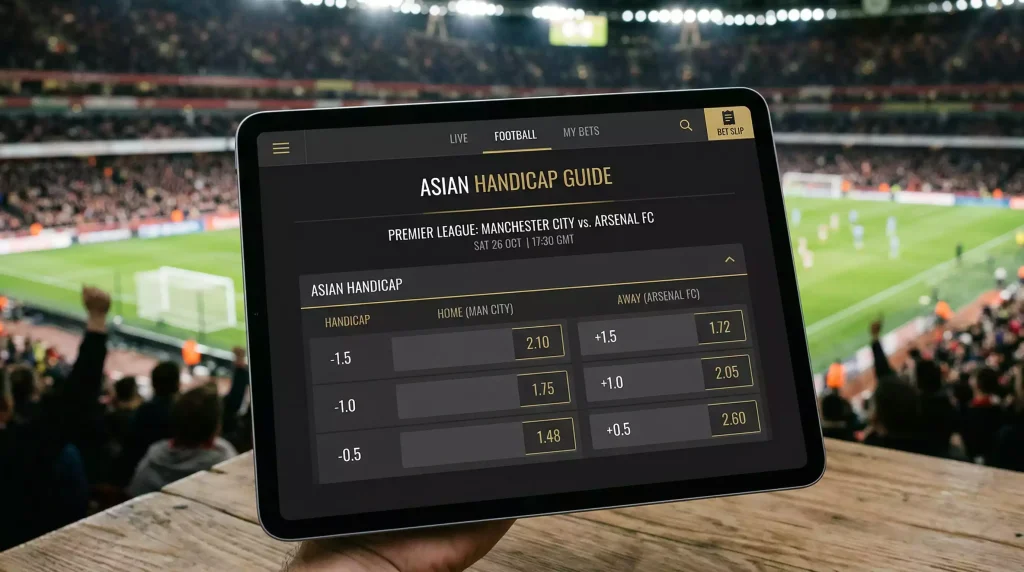
Table of Contents
I lost $400 on a draw. Germany versus Mexico, 2018 World Cup — I had the Germans at 1.35, felt bulletproof, watched El Tri score and park the bus. Final whistle, 1-0 Mexico, and my stake evaporated because I’d ignored the one market that could have saved half of it. That market was Asian handicap betting, and after eight years of covering international tournaments, I can tell you it’s the single most useful tool Australian punters overlook when wagering on the World Cup.
Asian handicap betting eliminates the draw from football matches by giving one team a virtual head start or deficit. For a tournament like the 2026 World Cup — where 48 teams across 12 groups will produce wildly uneven matchups — understanding this market separates recreational punters from those who extract consistent value. The format expansion means we’ll see more mismatches than ever: powerhouses like France or Argentina facing tournament debutants like Curaçao or Haiti. Standard 1X2 markets struggle with these fixtures because the favourite’s odds become absurdly short while the draw lurks as a stake-killer. Asian handicaps solve both problems by forcing you to think in margins rather than outcomes.
This guide breaks down exactly how Asian handicap betting works, walks through the different line types you’ll encounter, and shows you how to apply these concepts to specific World Cup 2026 scenarios. Whether you’re building match-day multis or hunting value on Group D fixtures featuring the Socceroos, Asian handicaps will sharpen your approach.
What Is Asian Handicap Betting?
Picture this: Brazil versus Haiti in Group C. The bookmakers price Brazil at 1.08 to win outright. You’d need to stake $1,250 just to profit $100, and if Haiti nicks a shock draw, you lose everything. Nobody with any sense takes that bet. But what if the question wasn’t “Will Brazil win?” but rather “Will Brazil win by more than three goals?” Suddenly you’re analysing actual football rather than stating the obvious.
Asian handicap betting reframes every match by applying a goal handicap to one team before kickoff. The favourite receives a negative handicap (they start with a virtual deficit), while the underdog receives a positive handicap (a virtual head start). Your bet settles based on the final score adjusted for the handicap. If Brazil starts at -3.0 and wins 3-0, the adjusted score is 0-0 — a push where your stake returns. If Brazil wins 4-0, the adjusted score becomes 1-0 Brazil, and your handicap bet wins.
The “Asian” prefix distinguishes this system from European handicaps, which typically use whole numbers and include three-way outcomes (win, lose, push). Asian handicaps originated in Indonesia and gained massive popularity across Asian betting markets because they eliminated the draw entirely — in most cases — by using half-goal and quarter-goal lines. The result is a cleaner two-way market with tighter margins and better value for punters who understand the mechanics.
For World Cup 2026, Asian handicaps become essential because the expanded 48-team format creates unprecedented competitive imbalance. When Germany faces Curaçao or England plays Panama, the 1X2 market offers nothing useful. But Germany -3.5 or England -2.0 transforms these fixtures into genuinely interesting betting propositions where your analysis of team quality, motivation, and tactical matchups actually matters.
The key mental shift is moving from “who wins” to “by how much.” Every Asian handicap bet forces you to quantify the gap between two teams. That discipline alone improves your betting because you’re no longer throwing money at favourites priced below 1.20 hoping nothing goes wrong. You’re making a specific claim about margin of victory and accepting risk commensurate with reward.
Types of Asian Handicaps
A mate of mine once placed what he thought was a bet on Argentina -1.0 without realising half his stake went to -0.5 and half to -1.5. He’d accidentally landed on a quarter-goal line. His confusion — and subsequent text messages — taught me that understanding line types prevents expensive mistakes. Let me walk you through each variant.
Whole Number Handicaps
Whole number handicaps like -1.0, -2.0, or +1.0 include the possibility of a push — a tied result after the handicap adjusts the score. If you back France -2.0 and Les Bleus win 2-0, the adjusted score is 0-0. Your stake returns in full. No win, no loss. Pushes frustrate punters who wanted a definitive result, but they also provide downside protection when matches land on exact margins.
At World Cup 2026, whole number lines appear most often in group stage matches between teams separated by 15-30 FIFA ranking positions. Think USA versus Paraguay in Group D — a fixture where the hosts might be priced around -1.0. If the Americans win 1-0, backers of USA -1.0 receive their stake back. That safety net makes whole number handicaps attractive for punters who believe a favourite will win but lack conviction about the margin.
The trade-off is slightly worse odds compared to half-goal lines. Bookmakers build in the push possibility when pricing whole numbers, so you’ll often find USA -1.0 at 1.95 while USA -1.5 pays 2.15. Deciding between them comes down to confidence: if you’re certain the margin exceeds one goal, take the half-goal line for better value. If you suspect a narrow win, the whole number protects your bankroll.
Half-Goal Handicaps
Half-goal handicaps like -0.5, -1.5, or +2.5 eliminate pushes entirely. Since no football match ends with half a goal, every bet settles as a winner or loser. This binary outcome appeals to punters who hate the ambiguity of stake returns and prefer knowing exactly where they stand.
The most common half-goal line you’ll encounter is -0.5 on the favourite, which functions identically to a match result bet. Backing Argentina -0.5 simply means Argentina must win — any winning scoreline settles your bet favourably. The advantage over 1X2 markets comes in pricing: Asian handicap -0.5 lines often offer marginally better odds than equivalent match result bets because the two-way market structure reduces bookmaker margins.
Where half-goals shine is removing that sick feeling when your team wins by exactly the margin you feared. If you take Spain -1.5 and La Roja wins 2-0, you celebrate without the “what if they’d scored one more” anxiety that accompanies whole number lines. The flip side: if Spain wins 1-0, you lose outright. There’s no soft landing.
For World Cup 2026 group matches between clearly mismatched teams — say, Belgium -2.5 versus New Zealand or France -2.5 versus Iraq — half-goal lines provide clean entry points. You’re making a straightforward claim about margin dominance, and the market rewards you fairly for that conviction.
Quarter-Goal Handicaps
Quarter-goal handicaps (sometimes called split handicaps) like -0.75, -1.25, or +1.75 confuse newcomers but offer the most nuanced positions in the Asian handicap universe. These lines split your stake equally between two adjacent handicaps. Backing Netherlands -1.75 means half your stake goes to -1.5 and half to -2.0.
The practical effect: quarter-goal lines create partial win/loss outcomes. If the Dutch win 2-0, your -1.5 portion wins (adjusted score 0.5-0) while your -2.0 portion pushes (adjusted score 0-0). You profit on half and return the other half. If they win 3-0, both halves win. If they win 1-0, both halves lose. Quarter-goals provide graduated exposure rather than all-or-nothing binary outcomes.
I use quarter-goal lines when I’m genuinely uncertain whether a margin threshold will be crossed. At World Cup 2026, consider Group H where Spain faces Uruguay — two quality sides where Spain might be favoured by around 0.75 goals. Taking Spain -0.75 means I win fully on a two-goal Spanish victory, half-win on a one-goal margin, and lose entirely on a draw or Uruguayan win. That risk/reward profile matches my uncertainty about the margin while still allowing positive expected value if I’ve correctly assessed Spain’s slight superiority.
Quarter-goal lines appear heavily in matches between evenly-rated opponents where bookmakers struggle to identify a clear favourite. Group F fixtures like Netherlands versus Japan might open at -0.25 or -0.75 depending on venue and team news. These tight lines reward punters who’ve done granular analysis on form, injury news, and tactical matchups.
How to Read AH Lines
The first time I saw a betting slip showing “Australia +0.5 @ 1.87 / +1.0 @ 1.54” I genuinely thought I’d clicked the wrong market. Reading Asian handicap lines fluently takes practice, but once you’ve cracked the notation, you’ll navigate these markets faster than traditional match result selections.
Standard notation lists the team, their handicap, and the decimal odds. “Germany -1.5 @ 2.05” means backing Germany with a one-and-a-half goal deficit — they must win by two or more for you to collect. “Japan +1.5 @ 1.85” means backing Japan with a one-and-a-half goal head start — they can lose by one, draw, or win for you to collect.
The handicap always appears from the perspective of the team listed. A negative number (-) indicates a deficit; a positive number (+) indicates a head start. Zero lines (0.0 or “level ball”) mean no handicap applies — effectively a match result bet without the draw option (stake returns if the match draws).
When lines show two numbers separated by a slash or comma, you’re looking at a quarter-goal split. “Brazil -2.25” means your stake splits between -2.0 and -2.5. Some bookmakers display this as “Brazil -2.0, -2.5” for clarity. Both notations mean identical bets.
For World Cup 2026, you’ll frequently encounter level ball and small handicaps in group stage fixtures between evenly-matched teams. Group L’s England versus Croatia might open at England -0.25 (split between 0.0 and -0.5), reflecting England’s slight favouritism without substantial margin conviction. In knockout rounds, handicaps tighten further as elimination stakes balance competitive edges.
One notation quirk: Australian bookmakers sometimes invert handicaps by listing the underdog first with their positive handicap. Instead of “Argentina -1.5 @ 1.90 / Jordan +1.5 @ 1.95,” you might see “Jordan +1.5 @ 1.95 / Argentina -1.5 @ 1.90.” Same market, different presentation order. Always verify which team carries which handicap before confirming your selection.
Applying AH to World Cup Matches
Theory’s worthless without application. Let me walk you through how I’d approach three actual World Cup 2026 fixtures using Asian handicap betting, covering different competitive scenarios you’ll encounter throughout the tournament.
Group C delivers the clearest mismatch study: Brazil versus Haiti. Brazil enter as five-time champions with a squad featuring generational talent. Haiti qualified through CONCACAF’s expanded pathway and will contest their first World Cup since 1974. Bookmakers will likely price Brazil -3.5 somewhere around 1.95, meaning the Seleção must win by four or more for that bet to land.
My approach: I’d consider Brazil -3.0 at reduced odds (around 1.75) for the push protection if Brazil wins exactly 3-0. Tournament football produces cautious scorelines — Brazil might score three then protect the result. The -3.0 line acknowledges that while Brazil should dominate, a four-goal margin isn’t guaranteed against a team defending desperately for 90 minutes.
Group D offers a more competitive example: USA versus Australia. The Socceroos face the hosts in Seattle, where American crowd support and home advantage matter. USA might be priced around -0.75 to -1.0. This fixture requires nuanced thinking because Australia’s squad, while clearly weaker on paper, includes Premier League experience and tournament nous from Qatar 2022.
I’d lean toward Australia +1.0 at around 1.95. The Socceroos’ realistic goal is keeping matches tight to maximise third-place qualification chances. Graham Arnold (or his successor) will set up pragmatically against the hosts. A 1-0 or 2-0 American victory feels likelier than a three-goal blowout, meaning +1.0 captures the probable margin while offering push protection if USA wins by exactly one.
Knockout rounds demand different calculus. Imagine a Round of 16 matchup between Spain and Japan — entirely plausible given both teams’ group positions. Spain might be -0.5 to -0.75 favourites. But knockout football produces tight, cagey affairs where both teams fear elimination. I’d seriously consider Japan +0.5 (effectively backing Japan or draw in regular time) because Asian sides have repeatedly troubled European giants at recent tournaments.
The broader lesson: Asian handicaps force you to quantify competitive gaps rather than simply identifying winners. That quantification improves betting discipline because you’re constantly asking “by how much?” rather than accepting whatever odds the match result market offers.
When to Use Asian Handicaps
Not every World Cup bet benefits from Asian handicaps. Knowing when to deploy this market — and when standard alternatives serve you better — separates sophisticated punters from those who complicate their betting unnecessarily.
Use Asian handicaps when the 1X2 market offers poor value on favourites. Any time you’re eyeing a match result favourite priced below 1.50, the Asian handicap market almost certainly provides better risk-adjusted returns. Brazil at 1.10 to beat Haiti tells you nothing useful; Brazil -2.5 at 1.85 gives you a meaningful position with appropriate reward for the risk accepted.
Use Asian handicaps when you have a strong view on margin but less certainty about outright result. This scenario arises frequently in World Cup group stages where weaker teams fight for draws. You might believe England dominates Panama but remain uncertain whether England scores three or five. The Asian handicap lets you bet on English dominance without specifying exact scorelines, which over/under markets require you to assess more precisely.
Use Asian handicaps for building safer accumulators. A three-leg multi combining Argentina -1.5, France -1.5, and Spain -1.5 across their opening group matches likely offers better expected value than the equivalent match result accumulator. You’re accepting slightly longer odds per leg while eliminating draw-related variance — a worthwhile trade-off for accumulator construction.
Avoid Asian handicaps when betting on unpredictable knockout matches where you genuinely expect tight margins. A quarter-final between two evenly-matched sides — say, Germany versus Netherlands — might show level ball (0.0) or -0.25 lines that don’t offer meaningful value over standard match result markets. When handicaps tighten to near-zero, the Asian market’s structural advantage diminishes.
Avoid Asian handicaps when your edge comes from specific scoreline predictions. If your analysis strongly suggests a 2-1 result, correct score markets pay better than backing the favourite -0.5. Asian handicaps reward margin conviction, not scoreline precision.
At World Cup 2026, I’ll use Asian handicaps predominantly during the group stage where mismatches proliferate and teams play relatively open football. Once knockouts begin, I’ll pivot toward match result, both teams to score, and over/under markets where the tight competitive balance makes handicap lines less attractive.
Expert Verdict
Asian handicap betting transforms how you engage with World Cup 2026. Instead of staring at 1.15 favourite odds wondering whether the return justifies the risk, you’ll analyse matches through margin lenses that reward genuine football knowledge. That shift — from outcome prediction to margin estimation — produces more thoughtful betting and, over tournament length, better returns for punters willing to learn the mechanics.
Start with half-goal lines if you’re new to Asian handicaps. The binary win/lose structure simplifies outcomes while you build familiarity. Progress to whole numbers when you want push protection on uncertain margins, and reserve quarter-goal lines for matches where your analysis sits genuinely between two adjacent handicaps.
The 48-team World Cup 2026 format creates more mismatches than any previous tournament. Those mismatches generate the clearest Asian handicap value. When Germany faces Curaçao or Argentina plays Jordan, the 1X2 market fails you. Asian handicaps step in, let you quantify dominance, and pay you fairly for accurate margin assessment. That’s the edge I’m hunting when June arrives. Follow the complete betting guide for broader tournament strategy, but make sure Asian handicaps sit in your toolkit before kickoff.
