
BC Place: Australia vs Türkiye Venue Guide
 Available in US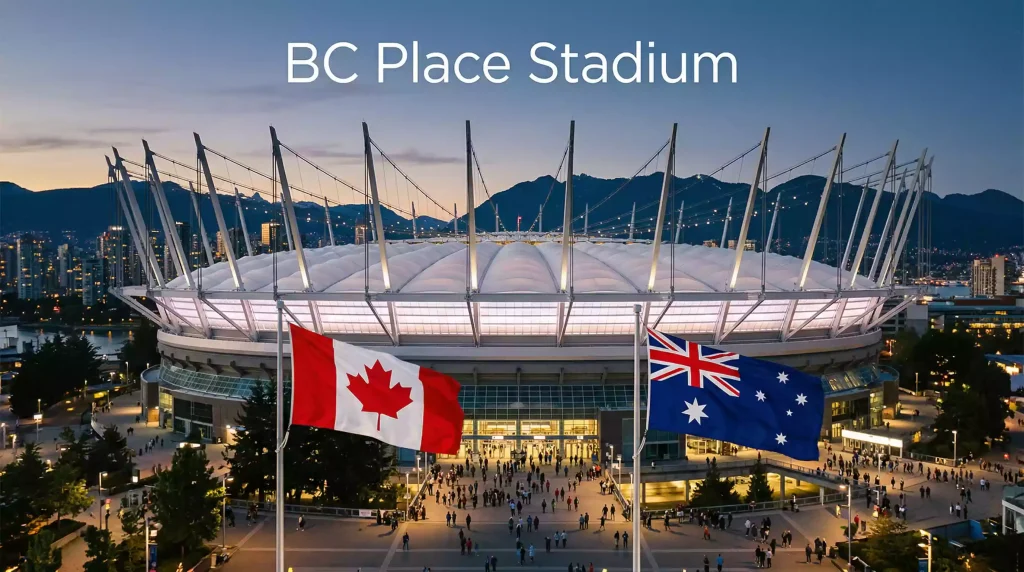
Table of Contents
Saturday, June 14, 2026. BC Place, Vancouver. The Socceroos open their World Cup campaign against Türkiye in Canada’s premier sports venue. This match sets the tone for everything that follows — victory here transforms a difficult group into manageable challenge, while defeat creates immediate pressure for remaining fixtures. For Australian supporters, BC Place becomes the first chapter of our 2026 story.
Vancouver’s location makes it the most accessible North American World Cup venue for Australian travelers. The Pacific time zone reduces jet lag compared to eastern cities, the city’s multicultural character welcomes diverse visitors, and its natural beauty provides compelling context for football pilgrimage. If you’re making the journey to support the Socceroos, Vancouver represents the starting point in more ways than fixture scheduling.
About BC Place
BC Place opened in 1983 as Canada’s first domed stadium, serving as the centrepiece venue for Expo 86 the following year. The original air-supported roof was replaced in 2011 with a retractable cable-supported structure that can open in approximately 20 minutes, transforming enclosed environment into open-air experience when weather permits. This flexibility ensures optimal conditions regardless of Vancouver’s variable climate.
The stadium serves as home to the Vancouver Whitecaps (MLS) and BC Lions (CFL), providing regular football operations that maintain pitch quality and facilities to standards World Cup organisers require. Capacity for soccer matches reaches approximately 54,000 after World Cup configuration adjustments, making BC Place smaller than some American venues but still substantial for tournament purposes.
Vancouver’s football culture has developed significantly since the Whitecaps joined MLS in 2011. The Southsiders supporter group brings organised support that creates atmosphere exceeding typical Canadian sports environments. This existing infrastructure benefits World Cup matches, ensuring passionate baseline crowds regardless of which nations contest each fixture.
Recent facility investments have modernised BC Place considerably. The 2011 roof replacement addressed structural concerns while improving spectator experience, subsequent renovations enhanced concourse amenities and technological infrastructure, and ongoing maintenance ensures the venue meets contemporary expectations. BC Place enters World Cup 2026 as Canada’s flagship sports facility.
World Cup 2026 Matches
BC Place hosts five World Cup matches, including the crucial Socceroos opener against Türkiye. The venue also hosts additional group stage fixtures and potentially a Round of 32 knockout match, ensuring Vancouver remains central to tournament action through the opening knockout phase. Canada’s co-hosting role guarantees significant fixture allocation across both Canadian venues.
The Australia versus Türkiye match represents BC Place’s most significant assignment from Australian perspective. Group D’s competitive dynamics mean this opener carries enormous weight — Türkiye have qualified for their first World Cup since 2002, arriving with a talented squad and nothing to lose. The Socceroos face opponents who’ll play with freedom that comes from exceeded expectations.
For Australian viewers, the match kicks off at approximately 2:00 AM AEST on Saturday night/Sunday morning. That overnight timing requires commitment, but season-opening matches for the Socceroos justify any sacrifice of sleep. We’ve waited four years since Qatar 2022 — a few hours of lost rest seems trivial by comparison.
Other BC Place fixtures feature various confederation representatives, though none carry direct Australian relevance after the Türkiye match. The venue’s atmosphere should remain strong throughout its assignments, with Vancouver’s diverse population ensuring support for teams from across the globe.
Socceroos Opener: Australia vs Türkiye
Türkiye’s return to World Cup football after 24 years creates unpredictable opposition. They haven’t experienced this stage since 2002’s third-place finish, and their current generation — featuring Real Madrid’s Arda Güler and Inter Milan’s Hakan Çalhanoğlu — possesses individual quality that demands respect. The Socceroos face opponents who’ve waited decades for this opportunity; motivation will not be lacking.
Australia’s preparation must account for Türkiye’s uncertainty. Without recent World Cup experience, Turkish patterns and responses under tournament pressure remain unknown quantities. This cuts both ways — opponents can’t prepare specifically for Turkish tournament football because no recent examples exist. The match becomes about execution rather than tactical preparation.
Tactically, the Socceroos might prefer controlled approaches that deny Türkiye’s technical players space to operate. Compact defensive blocks, disciplined positioning, and counter-attacking opportunities could neutralise the individual quality Türkiye possess in midfield. Opening matches often produce cagey football as both teams prioritise not losing over pursuing victory — a dynamic that suits Australian interests given subsequent fixtures against USA and Paraguay.
Betting markets should price this match relatively evenly. Türkiye might trade as slight favourites around 2.40, with Australia at approximately 2.80 and draws near 3.20. The value angle involves backing the draw at that price — opening match tension, comparable quality levels, and conservative tactical approaches all favour shared points. Under 2.5 goals at approximately 1.85 also attracts given likely caginess.
For Australian punters, this match represents the tournament’s most emotionally significant fixture regardless of knockout implications. Opening matches establish momentum, reveal squad character, and set expectations for everything following. Three points here transforms Group D calculus entirely; zero points creates pressure that compounds across subsequent fixtures.
Vancouver & The Pacific
Vancouver’s Pacific Rim positioning creates unique World Cup dynamics. The city’s multicultural composition includes significant Asian, European, and Latin American communities, ensuring diverse supporter bases for virtually every participating nation. This demographic reality means Australian supporters won’t feel isolated — friendly faces and familiar accents populate Vancouver’s cosmopolitan environment.
The city’s natural setting provides stunning context for World Cup pilgrimage. Mountains frame downtown skylines, ocean access offers respite from match intensity, and Stanley Park provides urban green space rivalling any city globally. Vancouver wants visitors to experience more than football; the city’s tourism infrastructure reflects genuine hospitality ambitions.
For Australian travelers specifically, Vancouver represents familiar territory in some respects. The city’s progressive character, environmental consciousness, and outdoor culture align with Australian values. English-language accessibility removes communication barriers, and the Pacific connection creates cultural affinities that ease travel adjustment. If you’re choosing which Socceroos match to attend in person, Vancouver’s accessibility advantages deserve consideration.
The time zone works favourably for Australian visitors managing jet lag. Vancouver operates on Pacific Daylight Time (PDT, UTC-7) during June, placing it 17 hours behind Sydney. This creates circadian challenges, but they’re manageable with sensible scheduling — arriving several days before the Türkiye match allows body clock adjustment before the most important 90 minutes of the tournament’s opening phase.
Getting There
BC Place sits in downtown Vancouver’s False Creek area, within walking distance from major hotels, transit connections, and entertainment districts. The venue’s central location distinguishes it from suburban American stadiums that require car-dependent access. Vancouver’s urban design prioritises walkability that World Cup visitors will appreciate.
Vancouver International Airport (YVR) serves as the arrival point for international visitors, with direct flights from Australian cities available (typically via connections). The Canada Line SkyTrain connects the airport to downtown Vancouver in approximately 25 minutes, terminating at Waterfront Station where BC Place is a short walk away. Public transit integration makes independent navigation straightforward.
Accommodation options span downtown hotels with maximum stadium proximity to neighbourhoods like Yaletown, Gastown, and Kitsilano that offer distinct character at various price points. Downtown locations minimise match day logistics; alternative neighbourhoods require transit connections that remain manageable but add time. Book early — Vancouver’s hotel capacity will strain during peak World Cup periods, and prices will reflect demand.
Match day logistics follow patterns familiar to anyone who’s attended major sporting events. Arrive at least two hours before kickoff to navigate security screening efficiently. Clear bag policies apply, prohibited item lists exist, and stadium entry procedures follow North American standards. BC Place’s operational experience with Whitecaps and Lions matches ensures efficient processing despite thorough security.
Vancouver’s June weather typically offers pleasant conditions — temperatures around 18-22°C with the possibility of rain that defines Pacific Northwest climate. BC Place’s retractable roof means weather concerns are minimal once inside, but dress for variable conditions when exploring the city. The roof will likely be closed for evening matches and open for afternoon fixtures depending on forecast.
Currency considerations matter for Australian visitors. Canada uses Canadian dollars (CAD), which typically trades at rough parity with AUD, simplifying mental conversion. Credit cards work universally, though cash remains useful for smaller purchases. Exchange rates fluctuate, but the Australian-Canadian currency relationship generally avoids the dramatic swings that complicate budgeting in other destinations.
Dining and entertainment around BC Place reflects Vancouver’s cosmopolitan character. Yaletown’s restaurants offer upscale options, Gastown provides historic atmosphere with modern gastronomy, and diverse neighbourhoods ensure cuisines from across the globe. Vancouver’s coffee culture rivals Australian standards — you won’t struggle finding quality flat whites despite being twelve thousand kilometres from Melbourne. The city accommodates Australian palates while offering opportunities for culinary exploration.
For complete Socceroos squad analysis, betting odds, and all three Group D fixtures, see our Socceroos World Cup 2026 guide.
