
World Cup 2026 Odds: Outright and Group Betting Markets
 Available in US
Table of Contents
Argentina defending their title at odds of 4.50 represents either a market overreaction to their 2022 triumph or the most justified short price we have seen for defending champions in two decades. The answer depends on how you weigh Lionel Messi’s likely final World Cup, the squad’s transition to a post-Di María era, and the physical demands of a 48-team tournament that requires winning seven matches rather than six. This World Cup 2026 odds analysis unpacks current pricing across every major market, identifies where bookmakers have misfired, and provides the framework to assess value as lines shift toward June kickoff.
The expansion from 32 to 48 teams has fundamentally altered outright markets in ways bookmakers are still calibrating. A larger field increases variance — more matches mean more opportunities for upsets, injuries, and momentum shifts. The Round of 32 addition means even the strongest sides must win an extra knockout match to lift the trophy, marginally lengthening odds across all contenders. Yet the market has not uniformly adjusted; some favourites remain priced closer to 32-team tournament expectations while middle-tier contenders have seen odds lengthen beyond mathematical justification.
Group betting markets offer the clearest value opportunities because the new third-place qualification rules create scenarios bookmakers historically ignore. When eight of twelve third-placed teams advance, pricing the gap between second and third place requires nuance that flat-percentage approaches miss. I have identified specific groups where market mispricing creates exploitable edges, and specific teams whose odds do not reflect their true advancement probability.
Key Numbers at a Glance
Before diving into analysis, here are the benchmarks shaping World Cup 2026 odds. Tournament winner prices range from Argentina at 4.50 down to debutants Haiti and Curaçao beyond 1000.00. The implied probability spread covers 22% (Argentina) to under 0.1% (minnows), with the top six contenders combining for approximately 65% of the implied probability pie — leaving 35% distributed across 42 other nations.
Group winner markets price favourites between 1.25 and 2.50 depending on perceived group difficulty. The tightest groups are F (Netherlands vs Japan, both around 2.40 to top the group) and K (Portugal vs Colombia, similarly competitive). The most lopsided is Group J, where Argentina sits at 1.25 to finish first despite facing Algeria, Austria, and Jordan. These discrepancies create arbitrage opportunities in group winner versus group stage exit markets.
Golden Boot prices see Kylian Mbappé leading at approximately 6.00, followed by Harry Kane (8.00), Erling Haaland (9.00), and Vinícius Jr (10.00). The wider field dilutes individual goal tallies — expect a winning total around 6-8 goals rather than the 8+ sometimes seen in 32-team tournaments. This compression actually creates value on volume shooters rather than clinical finishers, a dynamic I explore in the Golden Boot section below.
Socceroos-specific odds place Australia around 500.00 to win the tournament outright (0.2% implied), 2.80 to qualify from Group D (including third-place advancement), and 8.50 to win Group D outright. These prices reflect the challenging draw — hosts USA are heavy favourites at 1.60, with Türkiye second favourite at 3.20 and Paraguay the outsider at 6.00 alongside Australia’s 8.50.
Outright Winner Odds
Outright winner markets lock capital for the tournament’s duration but offer returns impossible to match through match-by-match betting. The current landscape sees a clearly defined top tier (Argentina, France, England, Brazil) followed by a competitive chasing pack and then progressively longer shots. Understanding why each tier is priced as it is — and where the pricing logic breaks down — is essential for identifying value.
The Favourites
Argentina at 4.50 leads the market as defending champions with the world’s best player potentially in his final major tournament. The Albiceleste’s pricing reflects their Qatar triumph, but also the reality that Messi will be 38 by the knockout rounds. Ángel Di María’s retirement from international football removes another talisman, placing greater creative burden on Julián Álvarez and younger attackers. Argentina’s strength remains midfield control through Rodrigo De Paul and Enzo Fernández, plus a settled defensive structure under Lionel Scaloni. The 4.50 price implies 22% probability — reasonable given their pedigree but arguably tight considering squad age concerns and the additional knockout round.
France at 5.50 offers the deepest squad in the tournament, a factor that compounds in importance across a potential seven-match run. Kylian Mbappé leads an attack supplemented by Ousmane Dembélé and whoever emerges from France’s embarrassment of riches (Randal Kolo Muani, Marcus Thuram, Bradley Barcola). The midfield transition from Pogba-Kanté to Tchouaméni-Camavinga has succeeded, and Didier Deschamps’ tournament record speaks for itself — World Cup winner in 2018, finalist in 2022, semi-finalist or better in five consecutive major tournaments. At 5.50 (implied 18%), France arguably offers better value than Argentina given their squad depth and tournament management expertise.
England at 7.00 represents the perennial “golden generation” narrative, though this time the squad genuinely warrants favouritism. Harry Kane’s goal record, Jude Bellingham’s emergence as a generational talent, and Phil Foden’s technical excellence create an attacking nucleus matching any rival. England’s tournament psychology has shifted under recent management — Euro 2020 and 2024 finals, 2018 World Cup semi-final, 2022 quarter-final — and the team no longer wilts under pressure as historical English sides did. Group L (Croatia, Ghana, Panama) presents manageable challenges, and the bracket draw could favour a run. At 7.00 (implied 14%), England sits correctly priced relative to their ceiling but perhaps slightly tight relative to their consistency converting chances in knockouts.
Brazil at 8.00 enters the tournament in transition but with talent that masks any structural uncertainty. The Seleção failed in 2022 (penalty shootout loss to Croatia in quarter-finals) despite being many analysts’ pre-tournament pick, and the intervening years have seen managerial changes and veteran departures. Yet Brazil’s quality remains undeniable: Vinícius Jr and Rodrygo from Real Madrid, Endrick’s emergence, and a midfield featuring Bruno Guimarães or Lucas Paquetá. The 8.00 price (implied 12.5%) reflects uncertainty rather than weakness, and Brazil’s historical tournament performance (five titles, most of any nation) supports value at anything above 10.00.
Dark Horse Contenders
Germany at 10.00 benefits from the Euro 2024 hosting boost — a home tournament semi-final restored confidence after the 2018 and 2022 World Cup embarrassments. Julian Nagelsmann’s tactical flexibility and the emergence of Florian Wirtz alongside established stars like Jamal Musiala creates a team capable of beating anyone. Group E (Curaçao, Ivory Coast, Ecuador) offers the softest draw among contenders, and Germany’s tournament efficiency historically improves in pressure environments. The 10.00 price (implied 10%) feels tight given recent inconsistency but justified if Nagelsmann has truly stabilised the squad.
Spain at 12.00 arrives as reigning European champions after their Euro 2024 triumph, featuring the youngest core of any contender. Pedri, Gavi, Lamine Yamal, and Nico Williams combine technical excellence with energy, while Rodri provides the midfield anchor. Spain’s challenge is converting possession dominance into tournament wins — they have not reached a World Cup final since 2010 despite controlling matches. Group H pairs them with Uruguay, a stern test that might actually benefit Spain by forcing early intensity. At 12.00 (implied 8.3%), Spain offers value if you believe their generation can replicate 2010’s glory rather than the subsequent underperformances.
Portugal at 16.00 faces the question of Cristiano Ronaldo’s role — will his presence inspire or constrain? At 41, Ronaldo cannot carry a tournament as he once did, yet his ego and status complicate squad dynamics. The supporting cast is exceptional (Bruno Fernandes, Bernardo Silva, Rafael Leão, João Cancelo), and Portugal’s defeat to Morocco in 2022’s quarter-finals reflected coaching limitations more than talent ceiling. New management and reduced reliance on Ronaldo could unlock Portugal’s potential. The 16.00 price (implied 6.25%) makes Portugal an interesting each-way proposition given their quality floor.
Netherlands at 20.00 always attracts sentimental money as the best team to never win a World Cup (three finals lost). Ronald Koeman’s second stint has brought stability, and the squad blends experience (Virgil van Dijk, Memphis Depay) with emerging talent (Xavi Simons, Jurriën Timber). Group F against Japan, Sweden, and Tunisia is competitive but navigable, and the Dutch record in neutral-venue tournaments historically improves. At 20.00 (implied 5%), Netherlands offers genuine outsider value if the draw cooperates and Van Dijk’s defence holds through seven matches.
Longshot Value
Morocco at 40.00 proved in 2022 that African teams can reach the World Cup’s final stages, and their squad has only improved. The Atlas Lions’ defensive solidity (three clean sheets in Qatar’s knockout rounds) remains their foundation, while attacking options have diversified through European club development. Group C against Brazil is tough but not insurmountable, and Morocco’s success in high-pressure knockout football makes them dangerous outsiders. At 40.00 (implied 2.5%), Morocco represents the best longshot value among proven tournament performers.
Colombia at 50.00 tends to fly under the radar despite consistently producing world-class talent. Luis Díaz’s Liverpool performances, James Rodríguez’s international revival, and a defence featuring Davinson Sánchez provides balance most 50.00 shots lack. Colombia qualified strongly from CONMEBOL, historically the toughest confederation, and Group K (Portugal, DR Congo, Uzbekistan) offers a clear path to the knockouts. The 50.00 price (implied 2%) underrates their quality relative to narrative-driven markets.
USA at 25.00 benefits from host nation advantage across most group and knockout venues. The American soccer development pathway has produced a golden generation — Christian Pulisic, Gio Reyna, Weston McKennie, Tyler Adams — supported by European experience and massive home support. Group D is tough (Australia, Türkiye, Paraguay) but the USA should advance comfortably, and a favourable bracket could see them reach the quarter-finals or beyond. At 25.00 (implied 4%), the price reflects genuine upset potential rather than pure patriotic inflation, though recreational money will shorten odds as the tournament approaches.
Group Winner Odds
Group winner markets offer better value than outrights because they resolve after just three matches, reducing variance and locking in returns before knockout unpredictability hits. The key to finding value is identifying groups where the favourite is overpriced or the second favourite is undervalued relative to actual advancement probability.
Group A sees Mexico at 1.80 as opening-match hosts, with South Korea (3.50), South Africa (6.00), and Czechia (7.00) trailing. Mexico’s home advantage in Estadio Azteca for the opener matters, but their recent form has been inconsistent. South Korea at 3.50 offers value given Son Heung-min’s quality and their Round of 16 run in 2022 — the Koreans consistently outperform expectations in World Cups and have the quality to top this group.
Group B prices Canada (2.20) as home favourites ahead of Switzerland (2.80), Bosnia and Herzegovina (4.50), and Qatar (5.00). This line underrates Switzerland, who reached the Euro 2024 quarter-finals and boast one of Europe’s most underrated squads. Canada’s home advantage is genuine but their squad depth remains unproven at the highest level. Switzerland at 2.80 to top Group B represents solid value.
Group C pits Brazil (1.50) against Morocco (3.50), Scotland (8.00), and Haiti (25.00). Brazil should advance but Morocco’s defensive strength makes them a genuine threat for first place. Scotland at 8.00 offers speculative interest as their best squad in decades — if they can split points with Morocco and beat Haiti convincingly, goal difference could see them through. Morocco at 3.50 to win Group C is the clearest value play.
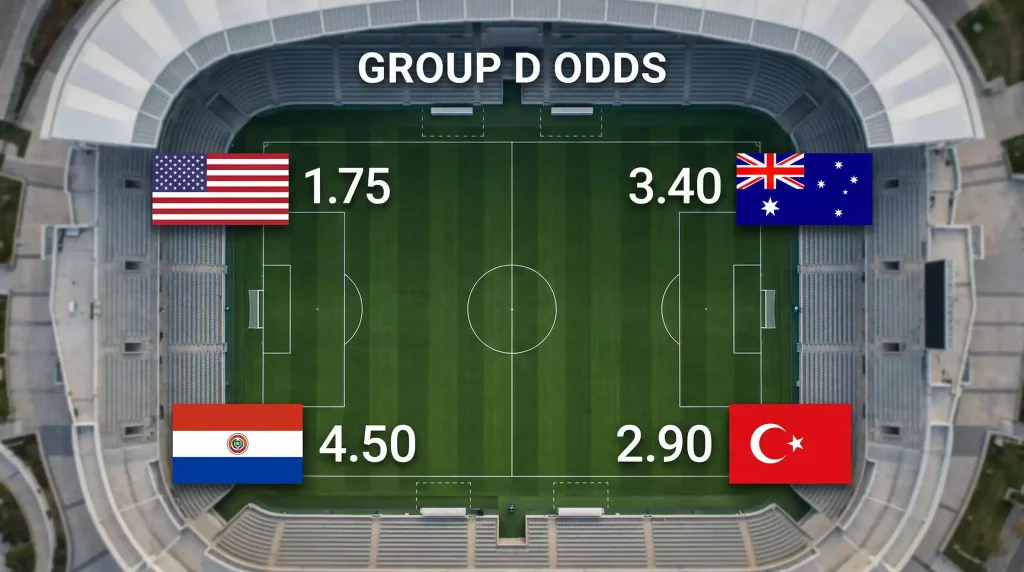
Group D features hosts USA (1.60), Türkiye (3.20), Paraguay (6.00), and Australia (8.50). USA’s home support across Seattle, Santa Clara, and likely knockout venues creates genuine advantage, but Türkiye at 3.20 offers value as a team returning to the World Cup after 24 years with elite talent (Arda Güler, Hakan Çalhanoğlu, Kenan Yıldız). Türkiye to top Group D at 3.20 is worth consideration despite USA favouritism.
Group E gives Germany (1.35) the easiest draw among contenders, facing Curaçao (30.00), Ivory Coast (6.00), and Ecuador (5.50). The 1.35 price (implied 74%) leaves little value on Germany, but Ecuador at 5.50 to finish second offers better returns than their true probability suggests. Germany will rotate players in dead rubbers, potentially allowing Ivory Coast (6.00) to steal second place with a strong final matchday.
Group F sets Netherlands (2.40) against Japan (2.50), Sweden (5.00), and Tunisia (7.00). This is the tournament’s most competitive group on paper, and the tight odds reflect genuine uncertainty. Japan at 2.50 offers identical probability to Netherlands at 2.40 despite bookmakers fractionally preferring the Dutch — Japan’s 2022 victories over Germany and Spain suggest they are correctly rated as equals. This market offers no clear edge; both Netherlands and Japan are fairly priced.
Group G sees Belgium (1.65) favoured over Egypt (4.00), Iran (5.50), and New Zealand (9.00). Belgium’s golden generation is aging — Kevin De Bruyne, Romelu Lukaku, and Eden Hazard’s various fitness concerns — but they remain superior on paper. Egypt at 4.00 offers value as Mohamed Salah leads a squad capable of defensive solidity and counter-attacking quality. New Zealand at 9.00 attracts Oceania interest but the All Whites lack the quality to compete with Belgium or Egypt consistently.
Group H pairs Spain (1.50) with Uruguay (3.00), Saudi Arabia (10.00), and Cape Verde (15.00). Spain should control this group, but Uruguay at 3.00 are underrated given their defensive organisation and tournament experience. Saudi Arabia’s 2022 victory over Argentina feels like a distant memory; their squad has not progressed. Spain to qualify looks certain, with Uruguay likely joining them regardless of finishing position.
Group I features France (1.30), Senegal (4.00), Norway (6.00), and Iraq (12.00). France’s price leaves no value, but Norway at 6.00 with Erling Haaland offers speculative upside. Senegal without Sadio Mané’s peak form are less formidable than their 2022 Round of 16 team, but still capable of second place. Norway toppling Senegal for second seems the likeliest upset scenario in this group.
Group J gives Argentina (1.25) the most prohibitive odds in any group, facing Algeria (5.00), Austria (6.00), and Jordan (15.00). Argentina will almost certainly top this group; the value question is whether Austria or Algeria can push for second. Austria at 6.00 boast a strong Bundesliga-based squad and represent the clearest value in Group J’s secondary markets.
Group K matches Portugal (1.80) against Colombia (2.60), DR Congo (6.00), and Uzbekistan (10.00). Colombia at 2.60 to top the group offers genuine value — they finished above Argentina in CONMEBOL qualifying and have the squad to match Portugal. This market feels mispriced, with Colombia deserving odds closer to 2.20 based on recent form.
Group L sees England (1.50) facing Croatia (3.50), Ghana (7.00), and Panama (12.00). England should progress comfortably, but Croatia at 3.50 represent familiar knockout-round danger. Luka Modrić’s age (40 by the tournament) raises questions, yet Croatia consistently punch above their weight at World Cups. Croatia at 3.50 is fairly priced rather than offering clear value.
Golden Boot Odds
The Golden Boot rewards the tournament’s highest scorer, with tiebreakers favouring fewer penalty kicks, then fewer minutes played, then most assists. In a 48-team tournament with 104 matches, goal distribution spreads wider than 32-team editions — expect a winning total around 6-8 goals rather than historical highs of 8-10.
Kylian Mbappé at 6.00 leads the market as France’s primary attacking threat. His pace, movement, and finishing quality are elite, and France’s squad creates abundant chances. The concern is France’s distribution of goals — Antoine Griezmann, Ousmane Dembélé, and various strikers all score regularly, potentially diluting Mbappé’s tally. At 6.00 (implied 16.7%), Mbappé is correctly priced as favourite but offers limited value.
Harry Kane at 8.00 represents England’s penalty taker and primary poacher, guaranteeing goal involvement if England progress deep. Kane’s international record (65+ goals) demonstrates consistent production, and England’s attacking system creates clear chances for their number nine. At 8.00 (implied 12.5%), Kane offers marginally better value than Mbappé given his penalty monopoly.
Erling Haaland at 9.00 carries Norway’s hopes of progressing from Group I. The challenge is twofold: Norway must advance for Haaland to accumulate games, and his club form (prolific volume) must translate to international football where service quality drops. If Norway finish second and reach the quarter-finals, Haaland could easily lead scoring. At 9.00 (implied 11%), he is a high-variance selection dependent on Norway’s progression.
Vinícius Jr at 10.00 benefits from Brazil’s attacking style and his own increase in goal output since joining Real Madrid’s front line. Brazil should progress deep, giving Vinícius abundant opportunities, and his reputation for big-game performances (Champions League final goals) suggests he rises for major occasions. At 10.00 (implied 10%), Vinícius offers value relative to Mbappé and Kane if you believe Brazil reaches the semi-finals or beyond.
The value in Golden Boot markets often lies in the 15.00-25.00 range where strikers from advancing teams get overlooked. Consider Julián Álvarez (15.00) as Argentina’s primary striker with Messi playing deeper; Romelu Lukaku (20.00) despite Belgium’s aging squad; or Memphis Depay (25.00) if Netherlands’ attack clicks. These prices offer return potential significantly exceeding their true probability disadvantage relative to frontrunners.
Stage-by-Stage Markets
Beyond outright winners and group victors, bookmakers offer markets targeting specific tournament stages. These provide hedging opportunities and allow punters to back teams whose ceiling they believe in without committing to ultimate triumph.
To reach the final markets price each nation’s chance of appearing in the MetLife Stadium decider on 19 July. Argentina (2.50), France (2.80), England (3.50), and Brazil (4.00) lead, with double-figure odds applying to Morocco (15.00), USA (12.00), and Netherlands (14.00). These markets let you bet on a team reaching the final without winning, essentially backing seven wins from eight possible. For teams like Netherlands (three finals lost, strong squad), the “to reach final” market at 14.00 offers value that outright winner at 20.00 does not — you profit regardless of their historical final-match collapses.
To reach semi-finals markets shorten odds further, with top contenders between 1.60 and 2.00. These prices reflect higher probability but lower payout — Argentina at 1.60 to make the semis implies 62.5% probability, leaving limited edge unless you assess their chances significantly higher. For middle-tier contenders (Colombia at 6.00, Türkiye at 8.00, Morocco at 7.00), these markets offer interesting each-way value.
Group stage exit odds flip the proposition, pricing teams to fail qualification. The minnows (Curaçao 1.10, Haiti 1.15, Cape Verde 1.25) offer no value at these prices despite near-certainty of elimination. The interesting plays are groups where tight competition makes exit probability significant: Sweden at 2.50 to exit Group F (they face Netherlands and Japan, both strong), Iran at 2.00 to exit Group G (Belgium and Egypt present stiff challenges), or even Croatia at 3.00 to exit Group L (aging squad, England and Ghana capable of beating them).
Correct score markets let punters target specific group-stage finishing positions. Argentina to finish Group J with 9 points (three wins) might pay 2.00, while finishing with 7 points (two wins, one draw) returns 3.50. These granular markets require intimate group knowledge but offer substantial returns when correctly anticipated.
Socceroos Odds Breakdown
Australia enters Group D with odds reflecting both the difficulty of their draw and the Socceroos’ historical tournament floor. Understanding each market helps Australian punters identify where value exists beyond patriotic backing.
Outright winner at 500.00 prices Australia’s chance at 0.2% — roughly equivalent to winning seven consecutive coin flips. This is accurate given the Socceroos would need to beat top-tier opponents repeatedly. There is no value at 500.00 unless you genuinely believe Australia can defeat France, Argentina, and England in knockout rounds, which historical evidence does not support.
Group D winner at 8.50 offers better analysis. USA at 1.60, Türkiye at 3.20, Paraguay at 6.00, and Australia at 8.50 reflects genuine competitive uncertainty after USA’s favouritism. If you believe Australia can beat Paraguay, hold Türkiye, and perhaps upset USA at Lumen Field in Seattle, 8.50 is generous. The Socceroos’ 2022 Round of 16 appearance demonstrated tournament resilience, and Jackson Irvine’s leadership plus Nestory Irankunda’s emergence suggest a squad capable of surprise. At 8.50 (implied 12%), Australia toppling the group requires favourable results but is not impossible.
To qualify from Group D at 2.80 includes finishing first, second, or third with enough points to be among the eight best third-placed teams. This is the most realistic target. Australia needs approximately 4 points to potentially qualify as best third (one win, one draw, or three draws historically suffices depending on goal difference). Against Paraguay at Levi’s Stadium, a victory is achievable; against Türkiye at BC Place in the opener, a draw is obtainable; against USA at Lumen Field, limiting damage matters. At 2.80 (implied 36%), qualification feels underpriced given the expanded format’s generosity to third-place finishes.
Individual match odds see Australia as underdogs throughout. Against Türkiye (opening match), Australia might sit around 3.50 with Türkiye 2.10 and draw 3.40. Against USA, Australia could be 5.00+ with USA 1.60 and draw 4.00. Against Paraguay, the market might show Australia 2.80, Paraguay 2.60, and draw 3.30. Match-by-match analysis is detailed on the Socceroos World Cup 2026 page, but the aggregate picture shows Australia competitively priced in achievable matches (Paraguay, Türkiye draw) and correctly long in the USA fixture.
Where’s the Value?
After surveying all major World Cup 2026 odds markets, specific value opportunities emerge. These are not predictions of what will happen but assessments of where market prices do not reflect true probability.
France at 5.50 to win outright offers superior value to Argentina at 4.50. France’s squad depth, tournament experience under Deschamps, and Mbappé’s peak years create a combination marginally underpriced relative to defending champions carrying squad transition concerns. If you want to back a favourite, France at 5.50 is the bet.
Morocco at 3.50 to win Group C over Brazil represents perhaps the clearest mispricing in group markets. Morocco’s defensive structure, which held Belgium, Spain, and Portugal scoreless in 2022 knockouts, can contain Brazil’s attack. The Atlas Lions need only one victory over Brazil and competent results against Scotland and Haiti to top the group — a realistic scenario priced at nearly 3/1 odds.
Colombia at 2.60 to win Group K over Portugal offers similar value in a less glamorous context. Colombia’s CONMEBOL qualifying form exceeded expectations, and their squad matches Portugal player-for-player in most positions. James Rodríguez’s international renaissance plus Luis Díaz’s Premier League quality creates a team deserving 2.20 odds or shorter. The 2.60 price reflects brand-name bias toward Portugal rather than objective analysis.
Austria at 6.00 to finish second in Group J (behind Argentina) prices attractively given their Bundesliga core and favourable matchups against Algeria and Jordan. Austria qualified comfortably through UEFA, play organised football, and have no history of tournament-stage collapse. At 6.00, they represent the type of “boring” value bet that consistently pays over multiple tournaments.
Australia at 2.80 to qualify from Group D offers value for reasons outlined above. The 48-team format’s third-place pathway creates mathematical probability that bookmakers underweight. Four points from three matches is achievable, and even three points (one win) might suffice depending on goal difference and other groups’ results. Australian punters seeking home interest at genuine value should back qualification rather than outright or group-winning markets.
Tracking Odds Movement
World Cup odds shift significantly between now and June 2026, and understanding why prices move helps identify optimal betting windows. Three primary factors drive movement: team news (injuries, retirements, form), market liquidity (recreational money influx), and information decay (early edges disappearing as kickoff approaches).
Injury news creates immediate odds adjustments. When France lost Paul Pogba and N’Golo Kanté before 2022, their odds drifted from 6.00 to 8.00 before recovering as squad alternatives emerged. Key players to monitor include Mbappé (any knock threatens France’s campaign), Van Dijk (Netherlands’ defensive anchor), and De Bruyne (Belgium’s creative fulcrum). Early-season club injuries can create buying opportunities if recovery is expected before June.
Recreational money floods markets in the final weeks before kickoff. Casual punters back familiar names — England, Brazil, Germany — regardless of odds value, shortening these teams’ prices while lengthening less fashionable contenders. If you identify value now in teams like Morocco or Colombia, waiting until late May risks worse odds as the market adjusts.
Information edges decay as tournaments approach. The bookmaker who mispriced Austria in February has corrected by May; the group-stage value in third-place qualification becomes common knowledge. Backing early means accepting less certainty about squad composition but capturing better prices. Backing late means maximum information but minimum value. The optimal balance typically falls 3-4 weeks before kickoff — squad selections announced, injury situations clarified, but recreational money not yet dominant.
Live odds during matches present the final tracking opportunity. Under Australian law, you must phone to place in-play bets, but monitoring price movements identifies sharp money direction. If Australia trails USA 1-0 but their odds to draw have shortened rather than lengthened, sharp bettors see something the scoreline does not reflect. This information can guide phone betting decisions even when you lack independent live analysis.
Strategic Approach by Market
Optimal strategy varies by market type, and treating all World Cup 2026 odds identically guarantees suboptimal returns. Outright markets, group bets, match betting, and player props each demand distinct approaches.
Outright markets favour early positioning and portfolio construction. Rather than backing a single tournament winner, spreading stakes across 3-4 contenders at varying prices hedges variance. Backing France at 5.50, Morocco at 40.00, and Colombia at 50.00 creates a portfolio where any success returns profit while limiting downside. Stake allocation should reflect implied probability — more on France, less on longshots — while maintaining positive expected value across each selection.
Group winner bets suit concentrated stakes where you hold strong conviction. These markets resolve after three matches, allowing capital recycling into knockout markets if initial bets succeed or fail quickly. Focus group bets on mispriced favourites (Morocco over Brazil) or underrated second-tier nations (Austria in Group J) rather than spreading across every group. Selectivity matters more than coverage.
Match betting requires game-by-game evaluation with the World Cup 2026 betting guide principles applied freshly each time. No pre-tournament strategy survives contact with actual matches — lineups, form, travel fatigue, and weather all affect pricing. Reserve bankroll for match betting rather than exhausting it on outrights and groups; the majority of World Cup betting opportunity comes during the 39-day tournament itself.
Player props demand specialist knowledge that general punters rarely possess. Unless you genuinely follow player form across multiple leagues and understand usage patterns under different managers, avoid Golden Boot and anytime goalscorer markets except for entertainment. The edge in player props belongs to dedicated football analysts, not generalists applying systematic approaches.
The overall strategic principle unifying all markets is selectivity. World Cup 2026 will present hundreds of betting opportunities; profitable punters exploit perhaps 20-30 across the tournament. Identifying which 20-30 require preparation — understanding odds formats, tracking movements, building probability frameworks — rather than inspiration on the day. Start that preparation now, bet selectively when opportunity arises, and accept that most markets offer no exploitable edge.
Expert Verdict
World Cup 2026 odds currently reflect a market adjusting to the 48-team format’s implications. Outright markets price the top tier fairly but undervalue middle-tier contenders with genuine upset potential. Group markets systematically misprice third-place qualification scenarios, creating value for punters who understand the new advancement mathematics. And Socceroos-specific odds, while respecting Group D’s difficulty, offer value in qualification markets rather than ambitious group-winning or outright positions.
My current positions target three areas: France at 5.50 outright as a slightly superior alternative to Argentina; Morocco at 3.50 to win Group C as the clearest group-stage mispricing; and Australia at 2.80 to qualify from Group D as a mathematically undervalued proposition in the expanded format. These represent conviction bets based on systematic analysis rather than hopeful speculation, and I will add match-by-match positions as the tournament unfolds.
Odds will shift between now and June — some current value will disappear, some new opportunities will emerge. Track team news, monitor recreational money flows, and position before the final weeks when markets tighten. The World Cup rewards preparation, and the 48-team format rewards punters who understand its structural differences from previous tournaments. Start early, bet selectively, and approach these odds with analytical detachment rather than tournament excitement.
