
Estadio Azteca: World Cup 2026 Opening Match Venue
 Available in US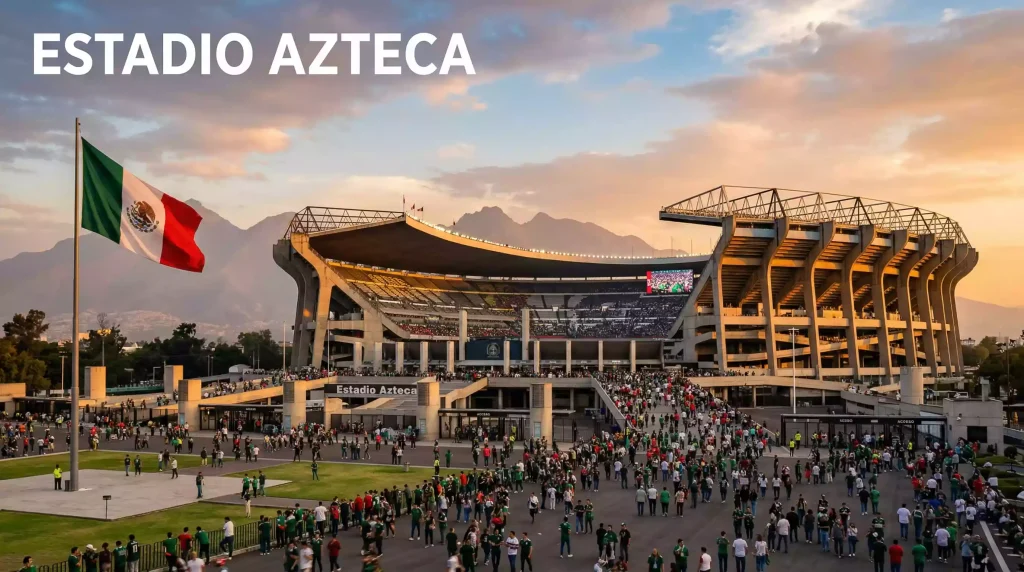
Table of Contents
Some stadiums transcend their physical dimensions to become shrines. Estadio Azteca is football’s cathedral — the only venue in history to host two World Cup Finals, where Pelé completed his trilogy and Diego Maradona achieved immortality with the Hand of God and the Goal of the Century in the same match. When World Cup 2026 opens on June 11 with Mexico versus South Africa, the tournament begins in the place where football’s greatest stories have been written.
The decision to award the Opening Match to Estadio Azteca recognised that no American venue, however impressive, carries equivalent historical weight. Mexico City’s altitude, the Azteca’s roar, the pressure that has crushed visiting teams for sixty years — these elements create atmosphere that purpose-built modern stadiums cannot replicate. FIFA understood that World Cup 2026 needed to begin with a nod to football’s heritage before celebrating North America’s future.
About Estadio Azteca
Opened in 1966, Estadio Azteca was built specifically to host the 1970 World Cup — a tournament that delivered some of football’s most iconic moments. The name derives from Mexico’s Aztec heritage, connecting the modern stadium to civilisations that inhabited the Valley of Mexico centuries before Spanish colonisation. That cultural weight permeates the venue’s identity, distinguishing it from sports facilities built purely for commercial purposes.
The stadium’s design accommodates 87,000 spectators, though reduced seating for World Cup matches brings capacity closer to 83,000 to meet FIFA’s safety and sightline requirements. Unlike many venues that prioritise enclosed environments, Estadio Azteca embraces open-air architecture that exposes players and fans to Mexico City’s elements — including the thin air at 2,240 metres elevation that affects athletic performance measurably.
Club América, Mexico’s most successful football club, calls Estadio Azteca home, as does the Mexican national team for virtually all significant matches. This regular use keeps the stadium operationally sharp, unlike venues used only for occasional events. The pitch receives constant attention, the facilities maintain excellent standards, and staff possess institutional knowledge accumulated across thousands of matches.
Recent renovations have addressed decades of wear while preserving the stadium’s essential character. Seating areas were replaced with modern installations, concourse amenities upgraded to contemporary standards, and broadcasting infrastructure expanded for the demands of global tournament coverage. Estadio Azteca enters World Cup 2026 respecting its history while meeting present requirements.
World Cup 2026 Matches
Estadio Azteca hosts the Opening Match — Mexico versus South Africa on June 11, 2026 — plus additional group stage fixtures and a Round of 32 knockout game. The assignment reflects both the venue’s historical significance and Mexico’s co-hosting role in the tri-nation tournament. FIFA ensured that Estadio Azteca’s World Cup contributions extend beyond ceremonial functions into genuine competitive football.
The Opening Match carries particular weight for Mexican football. Playing at home in Estadio Azteca, against South African opposition that Mexico should defeat, creates pressure to begin the tournament with victory that sets national expectations appropriately. South Africa’s potential to disrupt as 2010 hosts themselves adds narrative complexity — but Mexico’s home advantage in the world’s most intimidating stadium should prove decisive.
For Australian viewers, Estadio Azteca matches fall during accessible hours. The Opening Match kicks off at approximately 7:00 AM AEST — reasonable for early risers wanting to witness football history’s next chapter beginning. Group stage matches continue similarly, with Mexico City’s time zone (CDT, UTC-5) creating manageable conversions for Australian audiences.
The venue’s World Cup preparation has consumed years of planning. Altitude acclimatisation protocols were developed for teams arriving from sea level, broadcast positions expanded beyond typical capacity, and transportation coordination with Mexico City’s infrastructure required extensive municipal cooperation. Estadio Azteca enters the tournament as thoroughly prepared as its history demands.
Opening Match: Mexico vs South Africa
June 11, 2026. The moment World Cup 2026 transitions from anticipation to reality. Mexico and South Africa contest the Opening Match in front of 83,000 spectators at Estadio Azteca, with billions more watching globally. The host nation bears pressure that no other team experiences — winning is expected, losing is unacceptable, and every moment carries significance beyond the three points available.
Mexico’s preparation for this moment began when the co-hosting arrangement was confirmed in 2018. Their 2026 squad will have trained specifically for this fixture, understanding that the Opening Match establishes tournament momentum that carries through subsequent rounds. Coach and players will have visualised this scenario countless times — the roar of the Azteca, the weight of national expectation, the opportunity to begin perfectly.
South Africa arrive as 2010 hosts themselves, understanding tournament opening dynamics from their own experience. Bafana Bafana will approach the match without pressure — Mexican victory is expected, so anything else represents bonus achievement. That psychological freedom might actually help South African performance, allowing them to play without the paralysing anxiety that affects teams expected to win.
Betting markets price Mexico heavily for the Opening Match, typically around 1.45 for victory. South Africa’s win sits beyond 7.00, with draws around 4.50. The value angle might involve South Africa to score, priced around 1.85 — they should create opportunities against Mexican defenders nervous with opening match tension, and a goal would be celebrated regardless of final result.
A Legendary Venue
Two World Cup Finals. That distinction belongs to Estadio Azteca alone among football’s great stadiums. In 1970, Brazil defeated Italy 4-1 in perhaps the greatest Final ever contested, with Pelé, Jairzinho, Tostão and Carlos Alberto producing football that remains the sport’s gold standard. In 1986, Argentina overcame West Germany 3-2, completing Diego Maradona’s tournament of otherworldly brilliance.
The 1986 tournament produced moments that define football’s collective memory. Maradona’s quarter-final performance against England — the controversial handball goal followed immediately by the solo masterpiece — occurred at Estadio Azteca before 115,000 spectators. Both goals are replayed endlessly, analysed from every angle, and debated across generations. That single match cemented Estadio Azteca’s status as football’s most significant venue.
Beyond World Cups, Estadio Azteca has hosted countless defining matches in CONCACAF competition, Copa América fixtures, and international friendlies that drew football’s greatest names. Visiting teams famously struggle with the altitude, the atmosphere, and the sense that they’re competing against history itself. The venue’s record in competitive football reflects these advantages — few places on earth offer hosts comparable edge.
The stadium’s cultural significance extends beyond football. Concerts by the world’s biggest artists, papal visits, political gatherings — Estadio Azteca has served as Mexico’s primary venue for mass events across genres. This versatility demonstrates the facility’s operational flexibility while accumulating the institutional knowledge that World Cup organisers require from host venues.
For betting purposes, understanding Estadio Azteca’s influence on match outcomes matters. Mexico’s home record at the venue across World Cup qualifiers is exceptional — they rarely drop points there, and visiting teams consistently underperform their expected levels. The altitude affects aerobic capacity, the crowd intimidates opponents, and the historical weight adds psychological pressure that manifests in actual performance differences.
Mexico City Access
Estadio Azteca sits in the Coyoacán borough of Mexico City, approximately 15 kilometres from the historic centre. The stadium’s location within one of the world’s largest metropolitan areas creates logistical complexity that requires planning. Public transit options exist, but World Cup crowds will strain capacity in ways that everyday operations cannot predict.
Mexico City’s metro system connects to the stadium via Line 2 (Tasqueña direction), though the walk from stations to venue gates adds time that event planning must accommodate. For World Cup matches, enhanced shuttle services will supplement metro capacity, with dedicated routes from key gathering points across the city. Arrive significantly earlier than kickoff — two hours minimum for group matches.
International visitors typically fly into Mexico City International Airport (MEX), located east of the city centre. Accommodation options span from luxury hotels in Polanco and Reforma districts to budget alternatives throughout the sprawling metropolis. Consider staying in areas with direct metro access to simplify match day logistics, though taxi and rideshare services offer alternatives when public transit becomes overwhelmed.
Altitude affects visitors arriving from sea level. Mexico City sits at 2,240 metres, where air contains approximately 25% less oxygen than coastal cities. Allow acclimatisation time before match attendance if possible — arriving a day or two early helps bodies adjust. Hydration, reduced alcohol consumption, and gradual physical activity assist adaptation. The altitude that bothers visiting teams affects spectators too.
Security at Estadio Azteca follows Mexican protocols that differ from American venues. Expect thorough searches upon entry, restricted item policies, and crowd management approaches shaped by decades of hosting massive events. Cooperate with security personnel, arrive prepared with clear bags if required, and understand that procedures exist to ensure safety rather than inconvenience. The venue’s operational experience makes entry efficient despite thoroughness.
For complete tournament coverage including betting odds, team analysis, and match predictions, visit our World Cup 2026 betting hub.
